
Healthcare Industry
Teneo AI for Patient Logistics100% Output ControlBest Integrations EngineAI Agents for Patient Engagement
AI Agents for Healthcare. Governed. Compliant. Resolved.
- HIPAA Compliant
- SOC 2 Type II
- ISO 27001
- GDPR · EU AI Act
- 86+ Languages
- Any API or MCP
Why Teneo for Healthcare
Three things healthcare buyersneed to be true.
Healthcare AI procurement isn't a single concern — it's clinical safety, regulatory compliance, and operational outcomes, all evaluated independently. Teneo answers each.
Clinical Safety
Clinically governed, not probabilistically guessed
Compliance
Built for healthcare's compliance bar
Outcomes
Resolution, measured in production
The Proof
Medtronic, audited outcomesWhat resolved interactions look likeat scale.
With Teneo, we achieved better results than we could have imagined and the success in Cardiovascular led other contact centers to adopt the same approach.
Medtronic Case Study
Medtronic is the leading global healthcare technology company, supporting over 70 health conditions through cardiac devices, surgical robotics, insulin pumps, and patient monitoring systems.
Their contact center challenge was familiar: 63 call centers, 2,000+ agents, a legacy IVR, and cardiovascular patients — people calling about pacemakers and defibrillators — waiting longer than the clinical situation warranted. The system was deflecting calls, not resolving them. Teneo changed that.
Teneo was deployed first in the Cardiovascular Group — the highest-stakes unit, where every misrouted or unresolved call carried patient risk. The commercial and operational results were immediate.
The LLM PRODUCT Architecture Problem
Why LLM Products fail at healthcare scaleMost healthcare AI offers probabilistic output. Teneooffers deterministicgovernance.
Contained is not resolved
Legacy IVR deflected — it pushed calls into queues, dead ends, or self-service portals the patient couldn't navigate. Most AI platforms do the same thing with a more sophisticated front end. The call doesn't reach an agent, so it counts as "contained." The patient didn't get what they needed, so it isn't an outcome.
Handling is not accuracy
A generic LLM product puts a large language model in front of a chat or voice interface and generates responses based on prompts. It can handle interactions without a human agent. But it cannot guarantee consistency, or that the response is correct, protocol-governed, or clinically appropriate.
"Containment" is what your dashboard counts.
"Resolution" is what your patient experiences.
Where the llm product breaks
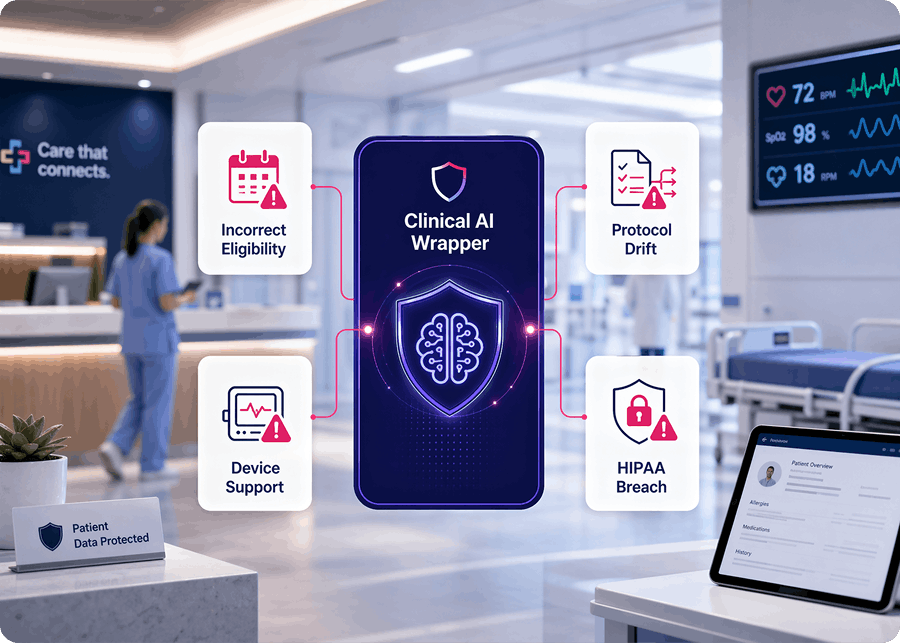
The problem isn't that LLMs give wrong answers intentionally. It's that they generate the most statistically probable response — which in a clinical context may differ materially from the correct, protocol-governed response. In healthcare patient engagement, the failure modes are concrete and consequential:
Triage protocol violations
An LLM summarizing triage protocols from prompts rather than applying your current clinical pathways may direct a patient to the wrong level of care — a delay that carries direct patient safety risk.
Device support failure
An LLM handling device support queries — a pacemaker alarm, an insulin pump error code — from a prompt rather than the manufacturer's approved troubleshooting guidance is a regulatory and safety exposure.
HIPAA compliance breach
An LLM processing patient health information without auditable PII scrubbing is a compliance violation, not a risk. Worse: an LLM that can be prompted to disclose Patient B's test results to Patient A is a breach event waiting to happen.
Incorrect appointment eligibility
An LLM giving a patient incorrect appointment eligibility based on generic data rather than actual insurance coverage and referral status creates downstream clinical and administrative failures.
These are not edge cases. Device support, clinical protocol guidance, appointment eligibility, and insurance verification are the core high-volume workflows in healthcare contact centers. They are also the workflows where the accuracy bar is highest and the consequences of error are most serious.
Certifications and compliance
THE STANDARDS Healthcare ACTUALLY REQUIRECertified for the compliance barhealthcare actually requires.
Healthcare organizations handle the most sensitive category of personal data — patient health information, diagnostic records, device performance data, insurance details. These are the certifications and capabilities your procurement and compliance team will require.
HIPAA
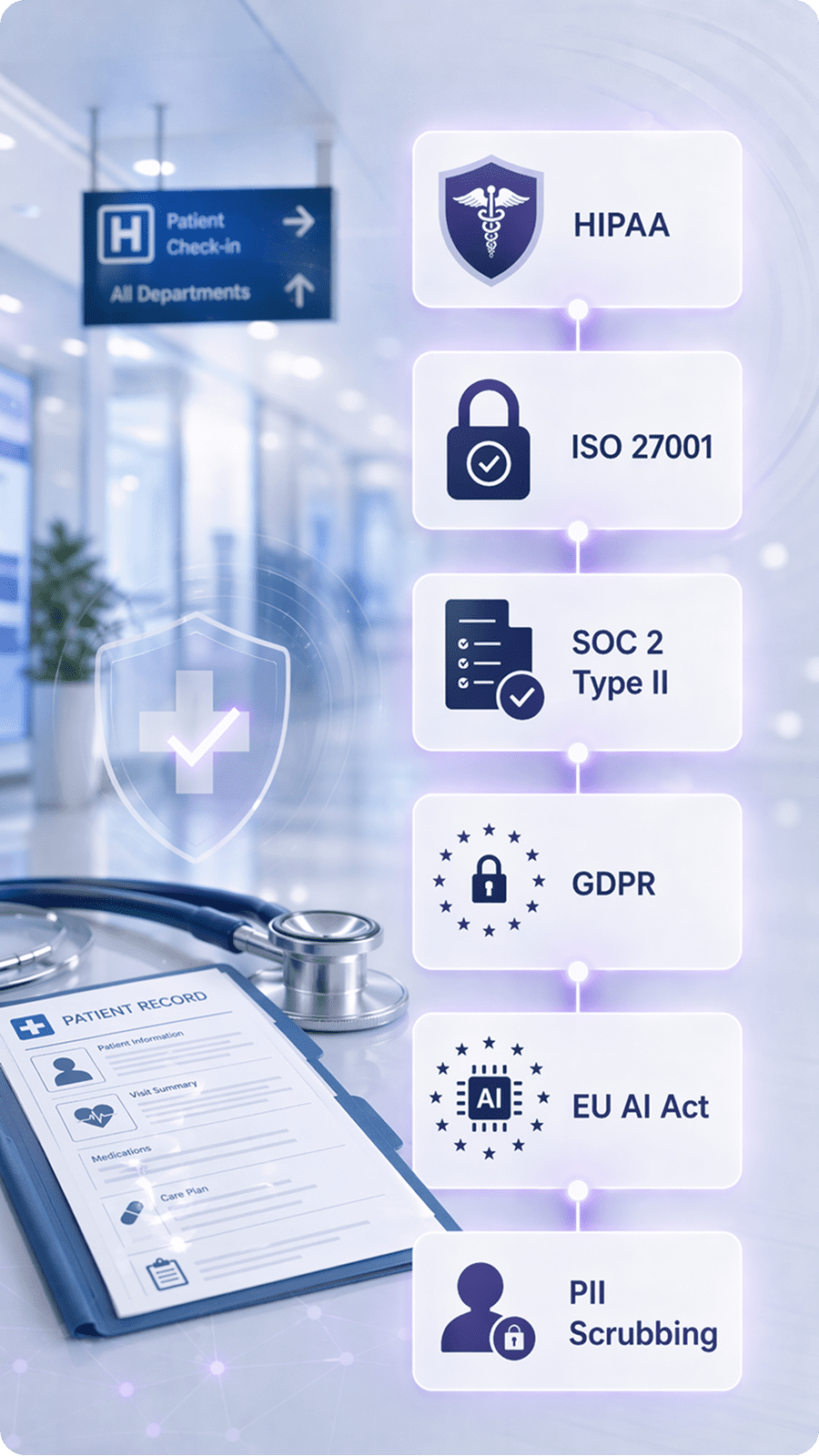
Teneo supports HIPAA-compliant deployments for all patient-facing workflows. Built-in PII detection and real-time scrubbing apply to every voice and chat interaction. Medtronic completed a multi-month vendor risk assessment with Teneo before scaling deployment — all findings remediated. Patient health information is never used to train public LLMs.
ISO 27001
Teneo's full organization is ISO 27001 certified. Information security management aligned to the international standard required by most enterprise healthcare procurement teams.
SOC 2 Type II
Independent audit of Teneo's security, availability, and confidentiality controls. Required by most enterprise healthcare procurement teams as a baseline for cloud-based AI platforms handling patient data.
GDPR
Patient data processed by Teneo is handled in compliance with GDPR. Data residency options available — EU-based deployment for European health systems with data sovereignty requirements.
EU AI Act
Teneo is compliant with the EU AI Act framework. Relevant for European healthcare organizations deploying AI in patient-facing workflows covered under the Act's requirements for high-risk AI systems.
PII scrubbing
Built-in PII detection and real-time redaction apply automatically to every interaction. Patient identifiers, health information, insurance details, and device data are masked and anonymized in logs. Full audit trail maintained for compliance reporting.
Built for the full healthcare buying committee
Healthcare AI procurement isn't asingle decision. Teneo answers eachstakeholder.
Will an AI response ever contradict our clinical protocols?
How is patient health information handled and audited?
How does this fit our existing architecture and data strategy?
Will this actually move my SLA, AHT, and CSAT numbers?
USE CASES
FROM appointments TO billingPatient interactions Teneoresolves end to end.
Teneo automates the high-volume workflows that determine whether your contact center deflects or resolves — with deterministic governance throughout.
Patient Scheduling
Device and Product Support
Billing and Administrative
Referral
- Referral status tracking
- Next-step guidance
- Real-time referral status lookups and pipeline position checks, answered instantly instead of waiting in an agent queue for a seconds-long system query
- Clear next-step explanations and required-action prompts pulled directly from system records
Every flow, policy-aware and production-ready. Teneo automates conversations end-to-end — not just FAQs — with guardrails your healthcare organization's operations and compliance teams can trust.
Proof Points
MEASURED IN PRODUCTION, NOT IN PITCHESThe numbers customersactually published.
6M
Cost saved by Medtronic with Teneo.
1.05
MPatient interactions handled by Teneo at Medtronic.
36K
Agent hours freed at Medtronic — redirected to interactions requiring human judgment.
54
%$25.96 → under $12 — Cost-per-contact in Medtronic's Cardiovascular Group, driven by interactions resolved by AI rather than handled by agents.
-55
%Reduction in misrouted calls at Medtronic — from 9% to 4%.
-37
%Reduction in patient wait time at Medtronic vs. pre-Teneo baseline.
86
+Languages supported natively from a single platform instance — covering multilingual patient populations.
2-4
weeksTypical pilot launch timeline from first discovery call to live patient interactions.
$9-10
Mcumulative savings in Cardiovascular Group
45
%YoY demand growth absorbed without proportional headcount
4-5
hrs/wGiven back to each field rep
6.7
ptsAbandonment rate decreased (14.7% → 6.8%)
Questions Answered
Frequently asked questionsHealthcare patient engagementAI, FAQ.
Is Teneo HIPAA compliant for patient-facing healthcare AI?
Yes. Teneo supports HIPAA-compliant deployments for patient-facing workflows. Built-in PII detection and real-time scrubbing apply to every voice and chat interaction. Patient health information is never shared with public large language models, and Teneo maintains SOC 2 Type II and ISO 27001 certifications alongside HIPAA compliance.
What results has Teneo delivered in healthcare?
Medtronic deployed Teneo across 10 business units and 60+ contact centers: $6M saved, 1.05M patient interactions resolved, 36,000 agent hours freed, misrouted calls reduced from 9% to 4%, wait time down 37%, and service level from 51% to 69%.
How quickly can Teneo deploy in a healthcare contact center?
Most healthcare pilots launch within 2 to 4 weeks of the first discovery call, with resolved interactions from day one of live traffic. Full deployment across patient scheduling, device support, billing, and clinical routing typically completes within 60 days.
How is Teneo different from a general-purpose LLM agent?
General-purpose LLM agents generate the most statistically probable response to a prompt. Teneo orchestrates LLMs through TLML — a deterministic governance layer that validates every response, action, and integration against your approved protocols before it reaches a patient. The LLM is one component of the agent, not the entire agent.
Ready to see what resolved looks like in your contact center?
Most healthcare pilots launch within 2 to 4 weeks. We'll walk through your highest-volume patient interactions and show you exactly where Teneo would deploy first.