
The global Conversational AI market is projected to reach $14.79 billion in 2025 and surge past $61 billion by 2032, growing at 22% CAGR. Yet organisations that rush to deploy Conversational AI without a structured approach routinely hit the same obstacles: low containment rates, poor accuracy in production, integration failures, and GDPR exposure.
This guide outlines the proven seven-step framework for how to deploy Conversational AI — and the decisions at each stage that determine whether your programme delivers ROI or a costly stall.
Why Most Conversational AI Deployments Underperform
The failure modes are well documented: only 7% of businesses report zero challenges when implementing AI tools. The core issues are not technological — they are architectural and strategic. Deploying a chatbot that deflects queries to an FAQ page, mismaps customer intent, or fails at the point of backend integration does not reduce costs. It creates customer friction and ultimately costs more than doing nothing.
The solution is not a better chatbot. It is a structured deploy Conversational AI methodology that starts with the right scope, trains on real customer data, integrates with live systems, and measures resolution quality from day one. Here is the step-by-step framework that Teneo uses with every enterprise deployment.
Step 1: Define Scope — Start Narrow, Scale Fast
The most common deployment error is attempting to automate too much simultaneously. Several methods focuses on use cases to deploy faster and perform better. The correct starting point is your top 5–10 call drivers by volume — the queries your contact centre handles most frequently and most repetitively.
Use CRM data, call transcripts, and IVR logs to identify these. Map them against automation suitability: structured workflows with clear resolution paths are ideal first targets. Teneo’s analytics capabilities surface call driver patterns automatically from your existing interaction data.

Step 2: Audit Your Existing Technology Stack
Before selecting a platform, map what you already have: your telephony/CCaaS stack (Genesys, Amazon Connect, and more), your CRM (Salesforce, Microsoft Dynamics, SAP), your ticketing system, and any legacy IVR. Understanding the integration landscape determines which platforms are viable and how complex your deployment will be.
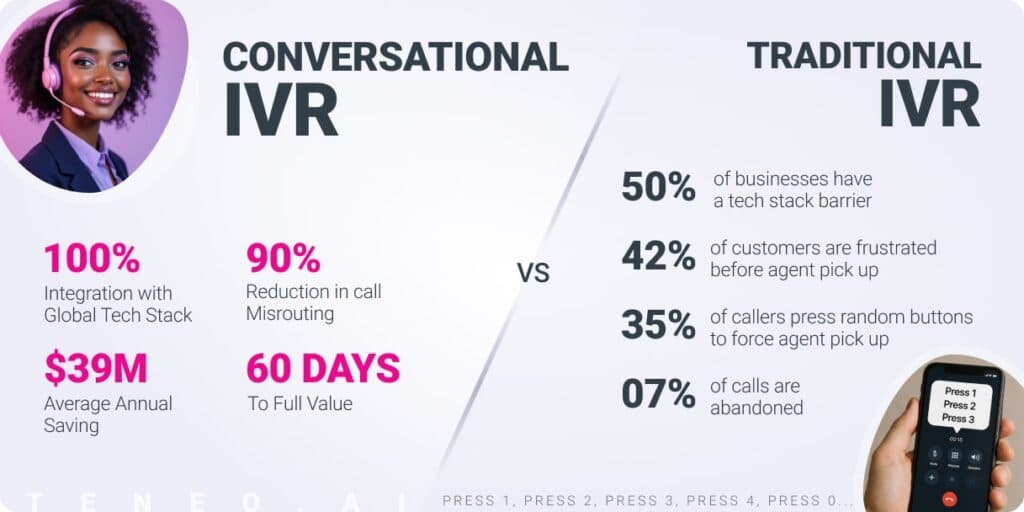
If you already have a functional IVR, you do not necessarily replace it immediately. You can layer conversational AI on top of or in front of your IVR — adding natural language understanding (NLU) to existing self-service flows before expanding scope.
Step 3: Select the Right Platform Architecture
The architecture decision is the most consequential in the deployment process. The choice is between:
- Pure LLM platforms: Flexible and quick to prototype, but prone to hallucination in production and lacking deterministic accuracy for regulated industries. High maintenance overhead.
- Rule-based chatbot platforms: Predictable but rigid. Cannot handle natural language variation, break on unexpected queries, require constant manual scripting.
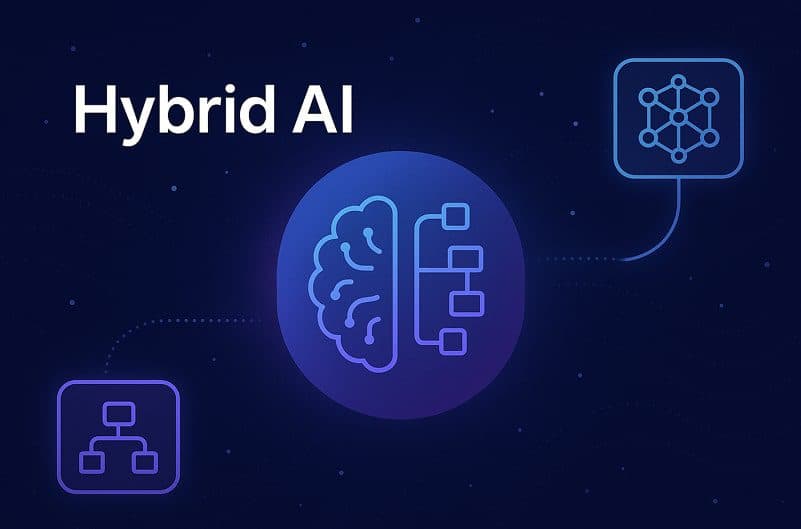
- Hybrid AI platforms (recommended for enterprise voice): Teneo’s Hybrid AI combines deterministic logic with LLM reasoning — achieving 99% production intent accuracy while preventing hallucination. Purpose-built for enterprise voice and digital at scale.
For contact centre voice automation specifically, architecture must also be voice-native: handling background noise, accents, interruptions, and multi-turn dialogue reliably. Most chat-first platforms retrofit voice — with predictable accuracy degradation in real-world conditions.
Step 4: Prepare Your Training Data
Conversational AI trained on sanitised, idealised example data fails when customers speak naturally. Real customers use incomplete sentences, switch topics mid-call, make typos, and express frustration in unpredictable ways.
Training data sources to prioritise: historical call transcripts, live chat logs, CRM case notes, IVR option selection patterns. Teneo AI includes enablement and onboarding to identify real call drivers, annotating intents, and building the domain model from your actual customer interaction history.
Step 5: Integrate with Backend Systems
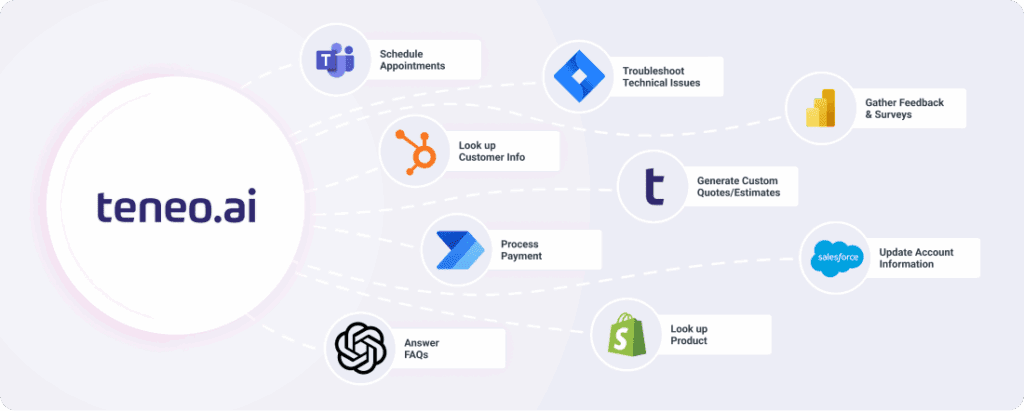
A conversational AI that cannot take action is a FAQ bot. Enterprise-grade deployment requires direct integration with the systems that hold customer data and enable resolution: CRM for account lookup, billing systems for payment and invoice queries, OMS for order tracking, ticketing systems for case creation, and telephony APIs for call routing. Teneo AI can be integrated with any LLM and MCP to connect to any enterprise system, including legacy infrastructure that requires UI-based interaction.
Step 6: Design the Human Escalation Model
Escalation design is as important as automation design. When a query exceeds the agent’s scope, the handoff must be seamless: full conversation context, customer intent, and interaction history transferred to the live agent. Customers should never have to repeat themselves.
Define your escalation triggers explicitly: confidence threshold below a minimum, emotional distress detected, query type outside defined scope, customer explicitly requests an agent. These are configuration decisions, not afterthoughts.
Step 7: Launch, Measure, and Iterate
The go-live is not the finish line. The KPIs to track from day one: containment rate (target: 40–60% for chat and voice), accuracy (target: 95%+ and higher for sensitive topics), CSAT on AI-handled interactions, cost per resolved interaction, and 7-day repeat contact rate.
Plan for quarterly review cycles in the first year.
Compliance and Security: Non-Negotiables for Enterprise Deployment
For EU-based operations, GDPR compliance is mandatory from day one. For financial services, FCA requirements apply. For healthcare, HIPAA. For payment flows, PCI DSS. Every conversational AI deployment that handles customer data is a compliance event. Teneo Security Center is compliant -across GDPR, ISO 27001, SOC 2, and HIPAA — with built-in PII protection, role-based access controls, and immutable audit trails.