

Agentic AI has moved from boardroom buzzword to board-level priority. Gartner forecasts that by 2026, over 40% of enterprise applications will embed task-specific AI agents — up from around 5% just two years earlier. Meanwhile, MarketsandMarkets estimates the global AI agents market will grow from approximately $5.2 billion in 2024 to $52.6 billion by 2030 — nearly a 10x expansion in under a decade.
But as the category has exploded, so has the noise. Rebranded chatbots are being marketed as “agentic” systems. Pilot-stage experiments are presented as production-grade deployments. And the difference between a company that has deployed AI agents at enterprise scale and one that is still running proofs of concept has never been harder to spot from the outside.
This guide cuts through that noise. We evaluate the best agentic AI companies in 2026 across the criteria that matter to enterprise leaders: autonomy depth, accuracy, integration maturity, security and compliance, scalability, and — most importantly — documented, measurable ROI.
What Makes a Company Genuinely “Agentic”?
Before comparing vendors, it is worth being clear about what the term actually means in a production context. Agentic AI refers to systems that can:
- Set and pursue goals autonomously — not just respond to prompts, but plan and sequence multi-step actions toward an objective
- Use tools and integrate with external systems — retrieve live data, execute transactions, update records, and trigger workflows in connected platforms
- Reason and adapt in context — handle ambiguity, recover from errors, and adjust strategies mid-task without human intervention
- Orchestrate multiple specialized agents — coordinate sub-agents with different capabilities to complete complex workflows no single agent could handle alone
- Operate within defined guardrails — maintain governance, security, and auditability at every step so enterprises can deploy with confidence
A company that offers AI-powered suggestions to human agents is not delivering agentic AI. A company whose system can autonomously identify a customer’s intent, retrieve their account history, execute a resolution, update the CRM, and route a follow-up — without a human in the loop — is.
That distinction drives the ROI numbers, which is why it matters so much for enterprise buyers.
Why Agentic AI Is the Biggest Tech Shift of the Decade
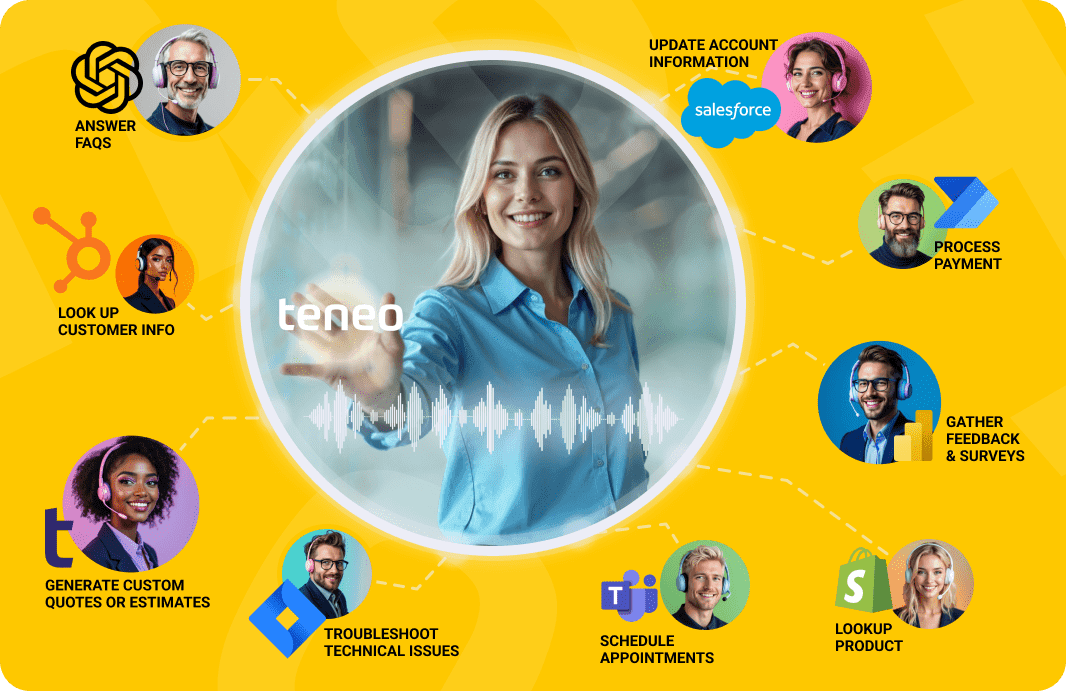
The scale of enterprise investment in this technology reflects how significant the shift is. Yahoo Finance highlighted agentic AI as the biggest tech trend of 2026, noting that the ability to manage and orchestrate AI agents across complex enterprise environments would become one of the most strategically valuable capabilities any software company could offer.
NVIDIA CEO Jensen Huang described agentic systems as a third major inflection point in AI — moving computing from a responsive tool to a production system that autonomously generates intelligence at scale. Deloitte’s 2025 Digital Transformation Survey found that enterprises leveraging agentic AI achieved a 35% reduction in decision-making time, a 42% improvement in resource allocation efficiency, and a 28% boost in employee satisfaction by eliminating routine workloads. McKinsey reports revenue increases of between 3% and 15% for companies deploying agentic systems effectively.
This is not a marginal efficiency play. It is a structural transformation in how enterprises operate. Before comparing vendors, it is worth understanding what enterprise conversational AI actually requires at scale — the four capabilities that separate platforms that survive a Fortune 500 deployment from those that produce a successful POC and then collapse under production load.
How to Evaluate the Best Agentic AI Companies
When assessing agentic AI vendors, enterprise buyers should evaluate across five dimensions:
1. Autonomy depth: Can the system execute complete, multi-step resolutions autonomously — or does it still require human confirmation at every decision point? Real agentic AI resolves. It does not just recommend.
2. Accuracy and reliability: Hallucinations are tolerable in a generative AI chat interface. They are unacceptable in an AI agent executing a refund, routing a critical case, or making a credit decision. What is the vendor’s documented accuracy rate in production, not in demos?
3. Enterprise integration: Agentic AI that cannot connect to your CRM, ERP, CCaaS platform, and legacy systems cannot execute. Integration depth is not a nice-to-have — it is the mechanism by which agents deliver value.
4. Governance and security: As enterprises deploy agents that act autonomously at scale, the ability to audit, constrain, monitor, and override agent behavior becomes critical. GDPR/CCPA compliance, audit logging, role-based access controls, and LLM guardrails should be non-negotiable requirements.
5. Proven ROI at scale: The ultimate evaluation criterion is not features — it is documented outcomes in production environments comparable to yours. What containment rates, cost savings, CSAT improvements, and revenue uplift have real enterprise customers achieved?
With that framework in mind, here are the companies leading the agentic AI landscape in 2026.
The Best Agentic AI Companies in 2026
1. Teneo.ai – Best for Enterprise Contact Center Automation
What they do: Teneo is the market-leading Agentic AI platform for contact center automation, voice AI, and omnichannel customer experience. Unlike platforms that entered the space from general-purpose AI tooling, Teneo was built from the ground up for high-volume, enterprise-grade customer interactions — with 20+ years of production deployment experience and over 17,000 AI agents currently running in live enterprise environments.
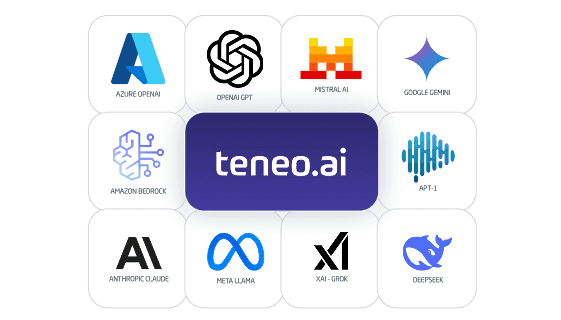
What makes it genuinely agentic: Teneo’s platform combines a patented Hybrid NLU architecture (integrating deterministic linguistic models with LLMs from providers including OpenAI, Anthropic, and Google) with autonomous reasoning and real-time system integration. Agents don’t follow scripts. They understand intent, reason through resolution paths, execute actions in connected systems, and escalate with full context only when the situation genuinely warrants a human. This is autonomous decision-making at enterprise scale, not enhanced routing.
Standout capabilities:
- 99% NLU accuracy in production, validated on the independent BANKING77 benchmark — the highest of any platform in the category
- 90%+ Tier 1 containment rates, reducing cost per call from the industry average of $5.60 to as low as $0.40
- LLM-agnostic orchestration — enterprises can use any large language model without vendor lock-in
- Native integrations with Genesys, Amazon Connect, Five9, Microsoft Azure, NICE, and all major CCaaS platforms
- 86+ language support across voice and digital channels
- ISO 27001 certified; GDPR/CCPA compliant; EU AI Act ready
Documented ROI:
- One enterprise customer saves $32.4 million per month through automated Tier 1 support
- Telefónica Germany handles 900,000+ voice interactions monthly with Teneo-powered agents
- HelloFresh achieves 30% chat automation across four global brands
- 60% average reduction in operational costs across enterprise deployments
- 6.7% average improvement in CSAT scores
Best for: Large enterprises in telecom, financial services, retail, insurance, and healthcare that cannot compromise on accuracy, compliance, or scale. Particularly strong for organizations with high-volume voice contact center environments.
2. Salesforce Agentforce — Best for CRM-Native Agentic AI
What they do: Agentforce is Salesforce’s AI agent layer built natively into the Salesforce Platform. It gives organizations the ability to deploy autonomous agents for service, sales, and marketing directly within their existing Salesforce CRM environment, drawing on Customer 360 data, Flows, and MuleSoft integrations.
What makes it genuinely agentic: Agentforce’s Atlas Reasoning Engine analyzes the full context of customer queries, formulates multi-step action plans, and executes them using Salesforce data and integrations — without preprogrammed conversational scripts. The recently launched Agentforce Contact Center unifies voice, digital channels, and CRM data in a single platform, enabling AI-to-human handoffs with complete context.
Standout capabilities:
- Native integration with Salesforce CRM, Data Cloud, and the full Customer 360 ecosystem
- Out-of-the-box agents for service, sales development, and field service
- The Einstein Trust Layer ensures PII masking and data governance within all LLM calls
- Agentforce Contact Center natively combines voice, AI, and CRM — eliminating fragmented tool stacks
Best for: Organizations already invested in the Salesforce ecosystem that want to layer agentic AI onto their existing CRM and service workflows without complex integration projects.
3. ServiceNow (with Control Tower) — Best for IT and Workflow Orchestration
What they do: ServiceNow is a leader in IT service management that has built an agentic AI orchestration platform — Control Tower — on top of its established workflow foundation. Its Now Assist generative AI suite has seen strong enterprise adoption, and its agentic capabilities now extend across IT, HR, procurement, and customer service.
What makes it genuinely agentic: ServiceNow’s Control Tower, enhanced by its acquisitions of Armis (asset visibility) and Veza (rights management), gives enterprises the ability to monitor and govern AI agents from any vendor across their entire environment. This makes it uniquely positioned for enterprises managing multi-vendor AI agent sprawl. The system assigns the most appropriate tasks to human workers, software bots, and AI agents based on cost-efficiency and capability.
Best for: Enterprises with complex IT environments that need centralized agentic AI governance across multiple vendors and systems.
4. UiPath (Maestro) — Best for RPA-to-Agentic Transition
What they do: UiPath started as the market leader in robotic process automation and has evolved its platform into Maestro, an agentic AI orchestration layer that governs both software bots and third-party AI agents within a unified compliance framework.
What makes it genuinely agentic: Maestro’s core value proposition is intelligent task assignment — routing work to the most appropriate resource, whether that is a software bot (cheaper, deterministic), a human worker, or a full AI agent. Its deep legacy system integrations, particularly with SAP and other enterprise platforms that lack modern APIs, give it a unique access advantage. Revenue growth accelerated to 16% in its most recent quarter.
Best for: Enterprises with significant existing RPA investments that want to evolve toward agentic AI without abandoning automation infrastructure already in production.
5. Microsoft (Azure AI Foundry + Copilot) — Best for Developer-Led Agentic AI
What they do: Microsoft has built an end-to-end agentic AI stack spanning Azure AI Foundry (model deployment and agent building), Microsoft Fabric (data orchestration), and Copilot (end-user agentic experiences in M365 and GitHub). With 15 million paid Microsoft 365 Copilot seats and Azure growing 39% year-over-year, Microsoft’s distribution is unmatched.
What makes it genuinely agentic: Azure AI Foundry enables enterprises to build, govern, and deploy multi-model AI agents at scale, drawing on Microsoft’s cloud infrastructure. Its agent-building tooling supports tool use, memory, and orchestration — and Copilot Studio allows business users to configure agents without deep technical expertise.
Best for: Organizations already committed to the Microsoft ecosystem and Azure cloud that want to build custom agentic workflows on top of enterprise infrastructure.
How These Companies Compare
| Company | Primary Strength | Best Vertical | Key Differentiator |
| Teneo.ai | Contact center automation | Telecom, Finance, Retail | 99% NLU accuracy; 90%+ containment; Voice-native |
| Salesforce Agentforce | CRM-native agents | Salesforce customers | Deep Customer 360 integration |
| ServiceNow | IT & workflow orchestration | IT, HR, Procurement | Multi-vendor AI governance |
| UiPath Maestro | RPA + agentic orchestration | Enterprises with legacy systems | Bot-to-agent task routing |
| Microsoft | Developer platform | Microsoft ecosystem | Scale and distribution |
What Enterprise Leaders Should Focus On in 2026
A few patterns are clear from evaluating these platforms:
Orchestration is the moat. The companies building platforms that can govern, coordinate, and assign work across multiple AI agents — rather than just deploying isolated agents — are the ones best positioned for long-term enterprise value. Both Yahoo Finance and the broader analyst community have identified orchestration capability as the key differentiator separating leaders from followers in this space.
Accuracy is not negotiable in high-stakes environments. In contact centers, financial services, and healthcare, a hallucinating AI agent is not an annoyance — it is a compliance risk, a revenue loss, and a customer experience failure. Documented production accuracy rates matter far more than benchmark claims in vendor decks.
ROI requires execution, not just recommendation. The companies achieving the most dramatic cost reductions and CSAT improvements are those deploying AI that resolves issues autonomously — not AI that assists human agents more efficiently. The structural economics only shift when agents remove human handling from the equation at volume.
Integration depth determines deployment success. Agentic AI that cannot connect to your existing CRM, CCaaS platform, and back-end systems cannot deliver on its promises. Evaluate integration maturity as carefully as model capabilities.
Why Contact Center Is Where Agentic AI ROI Is Highest
Among all enterprise use cases, contact center automation consistently delivers the fastest and largest return on agentic AI investment. The reasons are structural:
- Contact centers are high-volume, high-cost environments where the majority of interactions follow repeatable patterns that AI can resolve autonomously
- The cost-per-interaction economics are extreme: a fully-loaded human-handled call costs $3–6, while an AI-resolved interaction costs under $0.50
- Customer satisfaction improves when AI removes wait times and delivers immediate, accurate resolutions
- The data generated by contact center interactions continuously trains and improves the AI system over time
This is why Teneo — which was built specifically for this environment and has more than two decades of production experience — consistently delivers ROI outcomes that general-purpose agentic platforms cannot match in this specific use case. An EY 2026 study found that 59% of companies adopting agentic AI are doing so specifically to enhance customer-facing operations — and the enterprises seeing the highest returns are those deploying purpose-built platforms rather than adapting general-purpose tooling.
The Bottom Line
The best agentic AI companies in 2026 are not the ones with the most impressive demos or the largest funding rounds. They are the ones that have deployed autonomous AI agents in live enterprise environments, at scale, with documented ROI you can verify.
The landscape is bifurcating between general-purpose platforms offering broad agentic capabilities across many use cases and specialized platforms delivering domain-specific agentic AI at a level of depth and accuracy that general tools cannot match.
For enterprise leaders evaluating this technology, the decision framework is straightforward: start with your highest-volume, highest-cost problem. Identify the platform with the deepest expertise and most verifiable track record in that domain. And demand documented production outcomes — not pilot results, not capability claims — before committing.
Ready to see what purpose-built agentic AI can do for your contact center? Get in Touch!