

Key Takeaways (TL;DR)
- Beyond the Chatbot: The true value of Large Language Models (LLMs) lies not in simple chatbots, but in autonomous LLM Agents that can reason, make decisions, and execute tasks across enterprise systems.
- The Production Gap: A significant challenge for enterprises is moving from pilot to production. A 2025 report by MIT found that 95% of AI agent projects stall after the pilot phase, failing to deliver ROI due to a lack of a clear strategy and the right architecture.
- Orchestration is Key: The most critical component for success is an LLM Orchestration Platform. This layer acts as the central nervous system, managing the agent’s logic, state, tool use, and security, while remaining independent of the underlying LLM.
- A 5-Step Framework: This guide provides a practical, 5-step framework for building an enterprise-grade LLM agent, covering everything from use case definition to deployment and monitoring.
- Security and Cost Control: A robust orchestration layer like Teneo.ai is essential for solving the two biggest enterprise hurdles: preventing sensitive data from being exposed to public LLMs and managing the spiraling costs of API calls.
The Great Stagnation: Why Your LLM Pilot Isn’t Reaching Production
The launch of ChatGPT in late 2022 created a tidal wave of excitement, and enterprises rushed to build proofs-of-concept. Yet, nearly four years later, a surprising number of these projects are stuck in what can be called “pilot purgatory.” The initial thrill of a chatbot that can answer questions has faded, replaced by the hard realities of enterprise requirements: security, scalability, reliability, and demonstrable ROI.
The problem is a fundamental misunderstanding of the technology’s potential. The goal was never to build a better FAQ page. The goal is to create autonomous agents that can execute complex, multi-step tasks across your organization, from automating IT support to streamlining supply chain logistics.
This technical guide provides a strategic framework for enterprise architects, developers, and IT leaders to move beyond the pilot phase. It details how to build a robust, secure, and scalable LLM agent architecture that delivers real business value.
The Anatomy of an Enterprise LLM Agent
An LLM agent is more than just an API call to OpenAI. A true enterprise-grade agent is a sophisticated system composed of several distinct, interconnected components.
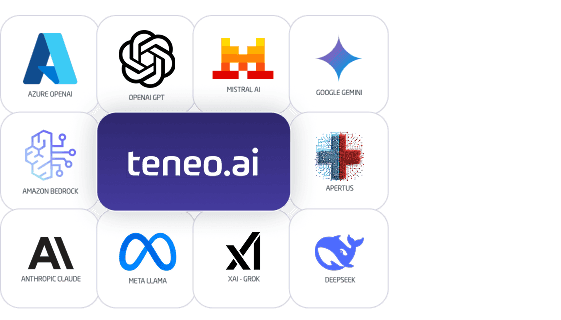
The LLM Foundation (The “Brain”): This is the core reasoning engine. While models like OpenAI’s GPT-5.3, Anthropic’s Claude Sonnet 4.5, and Google’s Gemini 3 are incredibly powerful, they are just one piece of the puzzle. The choice of model should be a strategic one, based on the task’s complexity, cost, and speed requirements.
The Orchestration Layer (The “Nervous System”): This is the most critical and often overlooked component. The orchestration layer is a dedicated platform that sits between the LLM and your enterprise systems. It is responsible for:
- Managing the agentic loop: The core “Reason-Act” cycle.
- State management: Remembering the context of a conversation or task.
- Tool selection and execution: Deciding which internal or external API to call.
- Security and access control: Ensuring the agent only accesses data it’s authorized to see.
- Cost optimization: Routing simple tasks to cheaper models and complex ones to more powerful models.
This is precisely the role Teneo.ai plays
Teneo provides the enterprise-grade LLM Orchestration layer that allows you to build a robust agent while maintaining full control and flexibility, independent of any single LLM provider.
The Tool Library (The “Hands”): These are the capabilities you give your agent. Each tool is typically a secure wrapper around an API that allows the agent to interact with the real world (e.g., a tool to check_inventory_status in SAP or a tool to reset_password in Active Directory). Teneo provides over 50 different open-sourced connectors to accelerate this process.
Memory (Short-Term and Long-Term): To perform complex tasks, an agent needs memory. This is often implemented using a vector database (like Pinecone or Weaviate) that stores conversational history and relevant documents, allowing the agent to retrieve information and maintain context over time.
A 5-Step Framework for Building Your First LLM Agent
Let’s move from theory to practice. Here is a step-by-step guide to building a production-ready LLM agent.
Step 1: Define a High-Value, Low-Complexity Use Case
Don’t try to boil the ocean. Your first agent should target a process that is frequent, repetitive and has a clear success metric. Examples include IT support password resets, HR policy questions, or simple sales qualification.
| Use Case | Business Value | Technical Complexity | Ideal First Project? |
| IT Password Reset | High (reduces helpdesk tickets) | Low (single API call) | ✅ Excellent |
| HR Policy Questions | Medium (improves employee experience) | Low (RAG on documents) | ✅ Excellent |
| Complex Financial Advice | Very High | Very High (requires multiple data sources, high accuracy) | ❌ No |
| Automated Code Generation | High | High (requires deep domain knowledge) | ❌ No |
Step 2: Select and Configure Your LLM Foundation
Choose your initial LLM based on your use case. For a simple Q&A agent, a smaller, faster model might be sufficient. For an agent that needs to perform complex reasoning, a state-of-the-art model like GPT-5 is a better choice. Your strategy should be to use an orchestration platform that is LLM-agnostic, allowing you to switch models as better or cheaper options become available.
Step 3: Design the Orchestration Flow with Teneo
This is where you define the agent’s logic. Using a platform like Teneo, you can visually map out the steps the agent will take. Let’s take the IT password reset example:
Trigger: User says, “I forgot my password.”
Teneo Logic: The Teneo orchestrator recognizes the password_reset intent.
Action 1 (Authentication): Teneo prompts the agent to call the authenticate_user tool, which could involve sending a verification code via an MFA API.
Teneo Logic: If authentication is successful, proceed. If not, escalate to a human agent.
Action 2 (Reset): Teneo prompts the agent to call the reset_password_in_ad tool, which interacts with the Active Directory API.
Teneo Logic: If the API call is successful, the agent confirms this to the user. If it fails, the agent logs the error and informs the user.
This entire workflow is managed within Teneo, providing a layer of control and observability that is impossible to achieve by coding directly against an LLM’s API.
Step 4: Build and Secure Your Tool Library
For each action your agent needs to perform, you must create a secure tool. This involves creating a dedicated, secure API endpoint that the agent can call. Crucially, never expose your internal databases or systems directly to the agent. The orchestration layer should be the only system authorized to invoke these tools, based on its defined logic.
Step 5: Deploy, Monitor, and Iterate
Deploy your agent in a controlled environment, starting with a small group of users. Monitor its performance closely:
- Accuracy: Is it correctly understanding intent and providing correct information?
- Cost: How many LLM calls is it making per interaction? Are costs within budget?
- Containment Rate: What percentage of requests is it handling without human escalation?
- User Satisfaction: Are users finding the agent helpful?
Use these metrics to continuously refine your agent’s prompts, logic, and toolset.
Solving Enterprise-Grade Challenges
Building a simple agent is easy. Building one that can operate securely and reliably in a complex enterprise environment is hard. Here’s how to solve the biggest challenges:
Security & Compliance
The Challenge: How do you use a public LLM without sending it your sensitive customer or corporate data?
The Solution: An orchestration platform like Teneo acts as a data firewall. The platform handles the interaction with the user, and when it needs to reason, it sends a generic, anonymized prompt to the LLM. For example, instead of sending “The user John Doe with account number 123 wants to know his balance,” Teneo sends “The user with ID 987 wants to know metric XYZ.” Teneo then retrieves the actual balance from your internal, secure database and presents it to the user. This ensures compliance with GDPR, CCPA, and other regulations. Security is the number one priority for a platform like Teneo; by using Teneo together with your LLM agent, you can ensure your customers’ personal data is never shared with any LLM. Learn more about our Top-Grade Security and Compliance.
Cost Management
The Challenge: A single complex query can trigger a chain of dozens of LLM calls, leading to unpredictable and spiraling costs.
The Solution: A smart orchestrator can dramatically reduce costs by implementing a tiered approach. It can use a small, cheap, local model to handle simple tasks like intent recognition and then invoke a large, expensive model like GPT-5 only for the specific step that requires powerful reasoning. Teneo’s architecture is designed for this kind of cost optimization. You can estimate your potential savings with our AI ROI Calculator.
Hallucination & Accuracy
The Challenge: LLMs are prone to “hallucinating” or making up incorrect information.
The Solution: Ground your agent in facts using Retrieval-Augmented Generation (RAG). This technique involves retrieving relevant information from your own trusted knowledge base (e.g., product documentation, HR policies) and including it in the prompt you send to the LLM. This forces the model to base its answer on your data, not its general training.
Teneo has built-in RAG capabilities and an Accuracy Booster technology to ensure your agent provides reliable, factual answers. Learn how to Control AI Responses in RAG.
Conclusion: Build, Don’t Just Buy
The era of the LLM agent is here. Enterprises that master this technology will create an insurmountable competitive advantage. However, success does not come from simply buying access to an LLM. It comes from strategically building an enterprise-grade agentic architecture with a robust orchestration layer at its core.
By following the framework outlined in this guide, you can move your AI initiatives out of pilot purgatory and into production, unlocking the transformative potential of autonomous AI to drive efficiency, improve customer experience and accelerate growth.
Ready to build your first enterprise-grade LLM agent? Book a demo with Teneo today to see how our orchestration platform can help you build, deploy, and manage secure, scalable and cost-effective AI solutions.
FAQ
What is an LLM agent?
An LLM agent is a type of artificial intelligence that uses large language models to understand and generate human-like text. These agents can perform a wide range of tasks, from customer support to content creation and data analysis.
How did LLM Chat GPT change the landscape of AI?
LLM Chat GPT demonstrated a remarkable ability to engage in coherent and contextually relevant conversations, setting a new standard for AI interactions. Its success has inspired many companies to develop their own LLM-based applications.
What are the benefits of using LLM agents in an enterprise?
LLM agents can enhance productivity, streamline processes, and improve customer experiences. They can handle customer inquiries, generate content, analyze data, support training and development, and facilitate internal communication.
How do LLM agents ensure data security and privacy?
LLM agents, when used with an enterprise-grade orchestration platform like Teneo, ensure security by anonymizing data before it’s sent to the public LLM. The platform acts as a firewall, ensuring compliance with regulations like GDPR and CCPA and preventing sensitive customer data from being exposed.
What future trends can we expect with LLM agents?
Expect increased personalization, deeper integration with APIs and enterprise systems, enhanced security measures, the rise of collaborative AI where multiple agents work together, and a stronger focus on ethical AI practices.
Subscribe to Our Newsletter

Ramazan Gurbuz
Product Marketing Executive at Teneo.ai with a background in Conversational AI and software development. Combines technical depth and strategic marketing to lead global AI product launches, developer initiatives, and LLM-driven growth campaigns.