

Voice AI Agents for Enterprise Contact Centers
99% Accuracy Across 86+ Languages. Native CCaaS Integration. Live in 60 Days.
Telefonica, HelloFresh and Swisscom run their voice AI on Teneo. The platform powers over 17,000 AI agents in production, handling millions of conversations daily across voice and digital channels with 99% accuracy in 86+ languages. Fully operational in 60 days.


The Difference Between Voice AI That Demos Well and Voice AI That Works at Scale
Most voice AI platforms hit a wall at enterprise scale. Accents break them. Complex phrasing confuses them. Multi turn conversations derail them. Teneo’s Hybrid AI architecture solves this with a combination that no other platform offers: deterministic TLML for precision, integrated with OpenAI GPT and Anthropic Claude for natural conversation. The result is voice AI that performs in production the way it performed in the demo.
99% accuracy in intent recognition, tested and proven in production
86+ languages from a single platform, no rebuild required
Native integration with Genesys Cloud, Amazon Connect, Five9, Microsoft, Nice, Google
SOC 2 Type II and ISO 27001 certified

Telefónica sets new industry standards for CAI projects
Customers all over Germany hated calling for support from Telefónica when dealing with keypad navigation. Until Open Question was implemented and changed everything…
Record levels of service
6% increase in call to resolution
1 million phone calls/month
Four languages covered
See Why Enterprises Choose Teneo for Voice AI
Book a demo and see how Teneo handles real enterprise voice interactions.
Top 10 Voice AI Agents for Contact Centers in 2026: Complete Guide —Executive Summary
This guide provides a comprehensive analysis of the top 10 voice AI agents for contact centers in 2026. We evaluated each platform on 10 key criteria, including accuracy, scalability, and compliance, to help you make an informed decision. Our key finding is that while many platforms offer impressive features, Teneo.ai leads the market with +99% accuracy validated on a real customer and sweeps all vendor satisfaction categories in the independent DMG Conversational AI Solutions Report, making it the top choice for enterprises that prioritize reliability and ROI. This guide will walk you through the current state of voice AI, our detailed evaluation framework, in depth reviews of each platform and best practices for implementation. Use this guide to identify the right voice AI partner for your specific needs and to understand the critical differences between market leaders and emerging innovators.

The conversational AI market is experiencing explosive growth, projected to expand from $11.58 billion in 2024 to $41.39 billion by 2030, a compound annual growth rate of 23.7%. Within this landscape, voice AI is the driving force, with the dedicated voice AI agents market expected to reach $47.5 billion by 2034. For contact centers, this is not a distant trend; it is a present day reality. A 2025 Zendesk report found that AI is expected to play a role in 100% of all customer interactions in the near future and our own research indicates that 85% of CX leaders are already piloting AI solutions.
2026 represents an inflection point where voice AI moves from a promising technology to an essential component of any competitive customer experience strategy. Early generations of voice AI were often rigid and frustrating, but modern platforms leverage advanced NLU and generative AI to deliver human like, context aware conversations. This guide provides a definitive overview of the current market, helping you navigate the complexities of choosing a voice AI partner. We will cover everything from the core technologies and market trends to in depth platform comparisons and implementation best practices, equipping you with the knowledge to make a strategic investment that delivers measurable returns.
A voice AI agent is an smart software entity that uses artificial intelligence to understand and respond to human speech, allowing it to automate conversations that would otherwise require a human agent. Unlike traditional Interactive Voice Response (IVR) systems that rely on rigid, 1980s technology like touch tone based menus, voice AI agents engage in natural, free flowing dialogue. They are powered by a sophisticated stack of technologies, including:

- Speech to Text (STT): Transcribes spoken words into text.
- Natural Language Understanding (NLU): Interprets the intent and meaning behind the text.
- Large Language Models (LLMs): Generate human like responses.
- Text to Speech (TTS): Converts the text response back into audible speech.
- Orchestration Engine: Manages the conversation flow and integrates with backend systems.
Voice AI architectures typically fall into two categories: pure LLM based systems, which are highly flexible but can be unpredictable and prone to hallucinations which can lead to legal implications, and Hybrid AI systems, which combine the reliability of a deterministic NLU engine with the creativity of LLMs. This hybrid approach, pioneered by platforms like Teneo.ai, combines deterministic NLU with LLM flexibility to deliver enterprise-grade multilingual conversational AI at scale across 86+ languages with 99+% accuracy. Real world use cases range from simple tasks like checking an account balance to complex workflows like troubleshooting a technical issue or processing a multi item order.
Voice AI is one channel within the broader category. The full set of enterprise conversational AI requirements — covering deterministic control, LLM independence, integration depth, and resolution reporting — applies across voice and digital channels alike.
The voice AI market in 2026 is defined by several key trends that are shaping enterprise adoption and platform development. The evolution from simple automation to Agentic AI is a major theme, where AI agents are no longer just responding to queries but are proactively executing tasks and making decisions. The risk of this is the lack of control over AI Agents, which can in an unmonitored and uncontrolled way communicate with your customers. Thus driving a clear preference for Hybrid AI architectures over pure LLM approaches, as enterprises require the reliability and control that a deterministic layer provides. Modern voice AI platforms deliver capabilities through cloud based IVR infrastructure, replacing the on-premise hardware that defined the previous generation of contact center technology.
The regulatory landscape is also becoming a critical factor. Legislation like the Keep Call Centers in America Act and various state level AI transparency laws in US are forcing companies to prioritize compliance and ethical AI deployment. Same pattern can be seen in Europe, with the EU AI Act being drafter fairly recently. This has put a spotlight on vendors that can provide robust security, data privacy, and auditability. Finally, the focus has shifted from speculative experimentation to measurable ROI. Enterprises are now demanding clear benchmarks, predictable performance, and a direct link between voice AI investment and key business metrics like cost reduction, customer satisfaction, and revenue growth.
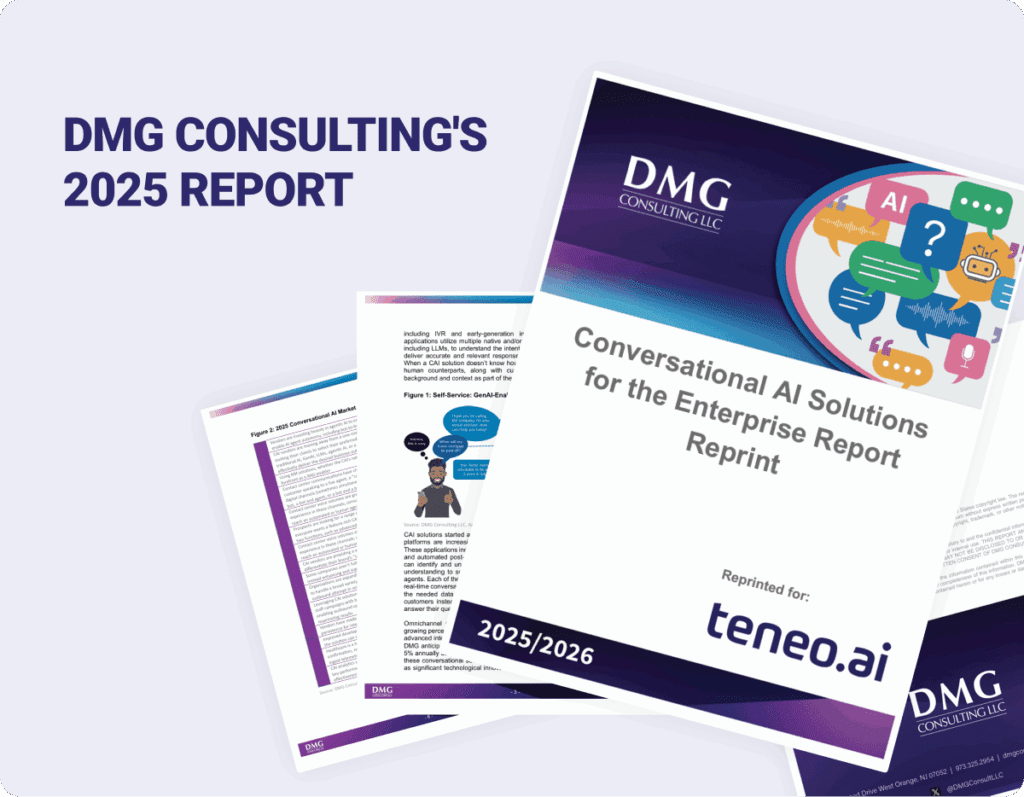
Our evaluation process was designed to reflect the real world priorities of enterprise buyers. We established a rigorous methodology based on 10 key criteria, each weighted according to its impact on business value and long term success. Our team of conversational AI experts analyzed product documentation, independent benchmarks like the DMG Conversational AI Solutions Report and customer case studies to create a comprehensive scoring framework. Our perspective is informed by Teneo.ai’s decade of experience in deploying large scale, mission critical voice AI solutions for Fortune 500 companies. This guide is not a simple feature comparison; it is a strategic analysis designed to help you choose a partner, not just a product.
We assessed each platform against the following 10 criteria:
- Conversation Quality: The ability to understand natural language, maintain context, and handle complex, multi turn dialogues.
- Accuracy & Reliability: Independently validated NLU accuracy scores, error rates and uptime guarantees.
- Scalability: The capacity to handle millions of concurrent calls across global data centers without performance degradation.
- Integration Capabilities: The ease of connecting with CRM, CCaaS and custom backend systems.
- Compliance & Security: Compliance for GDPR, HIPAA, and SOC 2, along with relevant and robust data handling protocols.
- Customization & Control: The availability of a wide audience, including the no code tools, drag and drop UI, APIs, and workflow flexibility to meet specific business needs.
- Multilingual Support: The number of languages supported and the quality of translation and localization.
- Analytics & Observability: The depth of reporting, transcription and performance monitoring tools.
- Pricing Transparency: The clarity of the cost model and the ability to project a realistic ROI timeline.
- Vendor Stability: The financial health of the vendor, the size of its customer base and the quality of its enterprise support model, as validated by third party reports like the DMG Conversational AI Solutions Report.
| Platform | Conversation Quality | Accuracy | Scalability | Integration | Compliance | Customization | Multilingual | Analytics | Pricing | Vendor Stability |
| Teneo.ai | Excellent | 99+% | High | Excellent | High | High | 86+ | Excellent | Transparent | High |
| Google DialogFlow | Good | 76% | High | Good | High | Medium | 90+ | Good | Opaque | High |
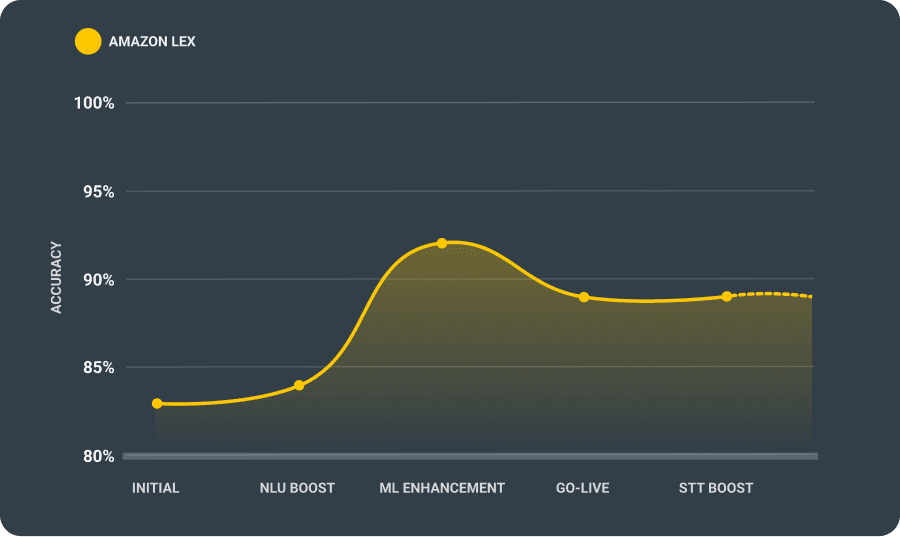
| Amazon Lex | Good | 89% | High | Good | High | Medium | 20+ | Good | Transparent | High |
| IBM Watson | Good | 81% | Medium | Good | High | Medium | 13+ | Good | Opaque | High |
| Microsoft Nuance | Excellent | N/A | High | Excellent | High | High | 40+ | Excellent | Opaque | High |
| Five9 IVA | Good | N/A | High | Excellent | High | High | 20+ | Excellent | Transparent | High |
| NICE CXone | Good | N/A | High | Excellent | High | High | 100+ | Excellent | Opaque | High |
| Genesys Cloud | Good | N/A | High | Excellent | High | High | 100+ | Excellent | Opaque | High |
| PolyAI | Good | N/A | Medium | Good | Medium | High | 30+ | Good | Transparent | Medium |
| Replicant | Good | N/A | Medium | Good | Medium | High | 30+ | Good | Transparent | Medium |
Teneo.ai stands out as the market leader for enterprises that demand the highest levels of accuracy, compliance, and reliability. With an independently validated +99% accuracy rate on their live customers, Teneo.ai significantly outperforms its competitors. This is achieved through its native Hybrid AI architecture, which combines the flexibility of large language models (LLMs) with the control of a deterministic NLU engine using Teneo’s Linguistic Modeling Language (TLML™). This unique approach, enhanced by the NLU Accuracy Booster™, provides the guardrails necessary for mission critical deployments in regulated industries. Further validating its market leadership, Teneo swept all 9 vendor satisfaction categories in the DMG Conversational AI Solutions Report 2025, achieving perfect scores in areas like Implementation, Pricing and Overall Vendor Satisfaction.
Enterprise Proof Points:
- Telefónica Germany: Handles over 900,000 monthly calls, increasing IVR resolution rates by 6%.
- Medtronic: $6M cost saved in 2022 and $9-10M cumulative Cardiovascular Group savings, cost per contact reduced from $25.96 to under $12, -37% wait time and +6% CSAT across 60+ contact centers.
- HelloFresh: Increased CSAT and reduced query volume through more effective self service.
- Swisscom: Deployed Teneo in 4 different languages to create an industry leading customer experience.
- Magnificent 7 Technology Leader: $22M monthly savings, 7 million monthly interactions handled across 42 languages, 10-week deployment, 99% accuracy, 90% Total Call Understanding.
Pros:
- Market leading +99% accuracy
- Top rated vendor satisfaction by DMG Consulting
- Hybrid AI for enterprise grade reliability
- Full compliance with GDPR, HIPAA, and SOC 2
- No vendor lock in with multi LLM support
- Deep integration capabilities
- Proven ROI with Fortune 500 companies
Best For: Large enterprises in any industry, (including finance, healthcare, telecom, technology, retail) that cannot compromise on hallucinations, accuracy or compliance.
Google DialogFlow is a strong contender for companies already invested in the Google Cloud ecosystem. It offers native speech recognition and powerful analytics. However, its 76% accuracy score on the BANKING77 benchmark indicates potential challenges with complex use cases.

- Core Strengths: Native speech recognition, Google Cloud integration, strong analytics.
- Limitations: A 23 point accuracy deficit to Teneo, less flexible outside the Google ecosystem.
- Best For: Companies standardized on Google Cloud with less complex intent libraries.
Amazon Connect with Lex provides unmatched scalability and a flexible, pay as you go pricing model. It achieved a respectable 89% accuracy score in Teneo’s benchmark, making it a solid choice for businesses with strong AWS expertise.
- Core Strengths: Serverless architecture, tight AWS integration, rapid deployment.
- Limitations: Requires significant in house expertise to manage and optimize.
- Best For: Businesses with strong AWS expertise and variable call volumes.
IBM Watson Assistant has a long history in the enterprise AI space and offers robust security features and hybrid deployment options. However, its 81% accuracy score suggests it may struggle with more nuanced user intents.
- Core Strengths: Advanced voice biometrics, strong security, hybrid deployment options.
- Limitations: Can be more complex to configure, accuracy gap may require manual tuning.
- Best For: Highly regulated industries needing on premise or hybrid cloud deployments.
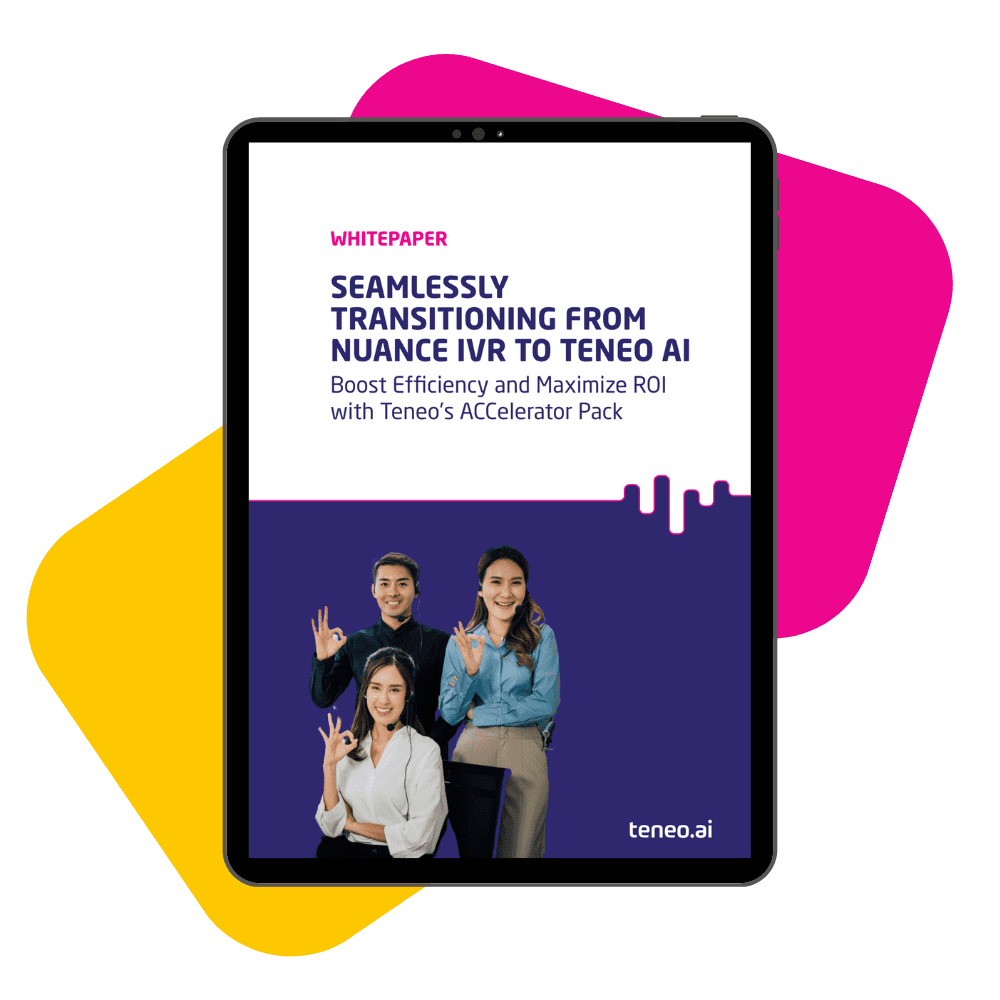
Microsoft’s acquisition of Nuance created a powerhouse in conversational AI, particularly for the healthcare and legal industries. Nuance Mix provides a robust platform for building sophisticated voice AI solutions, deeply integrated with Microsoft Azure and Dynamics 365.
- Core Strengths: Industry leading speech recognition, deep Microsoft ecosystem integration, strong enterprise focus.
- Limitations: Value is closely tied to adoption of the broader Microsoft stack.
- Best For: Companies heavily invested in the Microsoft Dynamics and Azure ecosystems.
- Critical: Microsoft Nuance is end of life and will not continue to be supported. Telefonica moved from Nuance to Teneo as part of this process, you can watch a webinar about their journey here.
Five9 is a leader in the CCaaS space, and its Intelligent Virtual Agent (IVA) is a natural extension of its platform. It offers a comprehensive suite of tools for building and deploying voice AI solutions, with a strong focus on omnichannel orchestration.
- Core Strengths: Deep omnichannel capabilities, extensive agent management tools, strong partner ecosystem.
- Limitations: Can be a monolithic solution; may require replacing the native bot layer for complex automation.
- Best For: Enterprises seeking a single, integrated platform for all contact center operations.
NICE CXone’s Enlighten AI provides a powerful layer of analytics and insights on top of its CCaaS platform. It analyzes interactions with customers to identify behavioral trends and automate processes, making it a strong choice for data driven contact centers.
- Core Strengths: Advanced behavioral analytics, pre built AI models, deep data insights.
- Limitations: AI capabilities are tightly coupled with the CXone platform.
- Best For: Data driven contact centers focused on optimizing agent performance and customer behavior.
Genesys is another long standing leader in the contact center industry. Its recently invested in more AI capabilities are added in its Cloud CX platform, offering a all in one solution for enterprises looking to modernize their contact center operations.
- Core Strengths: Deep omnichannel orchestration, extensive management tools, large partner ecosystem.
- Limitations: AI functionalities are severely limited and very prone to hallucinations.
- Best For: Enterprises seeking a single, integrated platform for all contact center operations but does not want to do any AI.
PolyAI is a specialist in customer led conversational AI, focusing on creating incredibly lifelike and natural voice assistants.
- Core Strengths: Conversational AI design, with access to NLP for natural conversations.
- Limitations: Heavily dependant on LLMs and prone to hallucinations.
- Best For: Companies looking to automize FAQ related flows and nothing complex.
- Please see PolyAI and best alternatives in 2026 for more info.
Replicant provides a powerful platform for automating high volume customer service conversations. It has limited successful case studies with global enterprises.
- Core Strengths: Access to voices, no code/low code building.
- Limitations: A newer player in the market, may not have the same track record as more established vendors. No significant IP, mostly LLM wrapper.
- Best For: Companies looking to build a RAG bot and are not scared of hallucinations.
| Feature | Teneo.ai | Amazon | IBM | Microsoft | Five9 | NICE | Genesys | PolyAI | Replicant | |
| Hybrid AI | ✅ | ❌ | ❌ | ❌ | ✅ | ❌ | ❌ | ❌ | ❌ | ❌ |
| NLU Accuracy | 99% | 76% | 89% | 81% | N/A | N/A | N/A | N/A | N/A | N/A |
| Compliance | High | High | High | High | High | High | High | High | Medium | Medium |
| No Code Builder | ✅ | ✅ | ✅ | ❌ | ✅ | ✅ | ✅ | ✅ | ✅ | ✅ |
| Industry | Teneo.ai | Amazon | IBM | Microsoft | Five9 | NICE | Genesys | PolyAI | Replicant | |
| Finance | Excellent | Good | Good | Excellent | Excellent | Good | Good | Good | Good | Good |
| Healthcare | Excellent | Good | Good | Excellent | Excellent | Good | Good | Good | Good | Good |
| Telecom | Excellent | Good | Excellent | Good | Good | Excellent | Excellent | Excellent | Good | Good |
| Retail | Excellent | Excellent | Excellent | Good | Excellent | Excellent | Excellent | Excellent | Excellent | Excellent |
| Travel | Excellent | Excellent | Excellent | Good | Good | Excellent | Excellent | Excellent | Excellent | Excellent |
| Other industries | Excellent | Good | Good | Good | Good | Good | Good | Good | Good | Good |
- Customer Support Automation: Answering common questions, providing account information, and resolving simple issues, with an expected ROI of 30-50% in cost savings.
- Lead Qualification and Sales: Engaging potential customers, qualifying leads, and scheduling sales appointments, with an expected ROI of 15-25% in increased sales.
- Appointment Scheduling: Booking, rescheduling, and confirming appointments, with an expected ROI of 40-60% in reduced administrative overhead.
- Order Processing and Tracking: Placing new orders, checking order status, and processing returns, with an expected ROI of 25-40% in operational efficiency.
- Technical Support Triage: Gathering initial information, performing basic troubleshooting, and routing complex issues to the right expert, with an expected ROI of 20-35% in improved first call resolution.
A successful voice AI implementation requires a strategic approach. A typical deployment takes 1 to 3 months and involves a phased rollout. Start with a pilot program to validate performance and measure initial ROI before expanding across the organization. Change management is critical; ensure that human agents understand how voice AI will augment their roles, not replace them. Common pitfalls to avoid include choosing a platform based on hype rather than proven performance, underestimating the complexity of integration and failing to define clear success metrics from the outset. For a deeper dive into this topic, watch our on demand webinar with DMG Consulting, CAI Implementation Best Practices That Deliver.
The evolution of voice AI is accelerating. Looking beyond 2026, we can expect to see the rise of Agentic AI, where voice agents move from passive assistants to proactive problem solvers that can reason, plan, and execute complex tasks. Multimodal integration will become standard, with voice seamlessly blending with text, video, and other channels for a truly unified customer experience. The regulatory landscape will continue to mature, making compliance and ethical AI a non negotiable foundation for any deployment. Teneo.ai’s roadmap is closely aligned with these trends, with a strong focus on advancing its Hybrid AI architecture to power the next generation of autonomous, multimodal, and compliant voice AI agents.
Choosing the right voice AI partner is a critical strategic decision. While the market is crowded with options, a clear leader emerges for enterprises that prioritize accuracy, compliance and proven ROI. Teneo.ai, with its market leading 99% accuracy, patented Hybrid AI architecture, and top satisfaction scores in the DMG Conversational AI Solutions Report, provides the safest and most reliable path to voice AI adoption.
As you move forward, use the evaluation framework in this guide to assess potential vendors and focus on partners that can deliver not just impressive demos, but measurable business results. The future of customer experience is here, and the right voice AI strategy will be the key to unlocking its full potential.
Frequently Asked Questions
1. What is the difference between voice AI and traditional IVR?
Traditional IVR uses rigid, 1980s like touch tone based menus, while voice AI engages in natural, free flowing conversations. Voice AI understands user intent regardless of how they phrase their request, providing a more human-like and efficient experience.
2. How accurate are voice AI agents for contact centers?
Accuracy varies widely. While some platforms struggle to surpass 80% accuracy, market leaders like Teneo.ai achieve up to 99% accuracy on industry standard benchmarks, thanks to advanced Hybrid AI architectures.
3. What is Hybrid AI and why does it matter?
Hybrid AI combines the reliability of a deterministic NLU engine with the flexibility of large language models. This is also the architecture behind enterprise conversational AI agents for business use. This is also how conversational AI chatbots differ from rule-based bots — the shift from keyword matching to true intent understanding. This approach provides the guardrails necessary for enterprise grade compliance and accuracy, avoiding the unpredictability of pure LLM solutions.
4. How long does it take to implement voice AI?
A typical enterprise deployment takes 1 to 3 months. In some cases, customers has deployed using Teneo in less than 30 days. For detailed guidance on accelerating this timeline while managing risk, watch our on demand webinar, CAI Implementation Best Practices That Deliver.
5. What ROI can companies expect from voice AI?
ROI can be significant, with many companies seeing a return on investment within 3 months. Key drivers of ROI include reduced agent handling time, increased first call resolution, and improved customer satisfaction.
6. Is voice AI compliant with GDPR and HIPAA?
Enterprise grade voice AI platforms like Teneo.ai are fully compliant with GDPR, HIPAA, and SOC 2. However, it is crucial to verify the compliance certifications of any vendor you consider.
7. Can voice AI integrate with existing contact center platforms?
Yes, leading voice AI platforms are designed to integrate seamlessly with all major CCaaS and CRM systems, acting as an intelligence layer that enhances your existing infrastructure.
8. What languages do voice AI agents support?
Language support varies by platform. While some support only a handful of languages, market leaders like Teneo.ai support over +86 languages, covering over 120+ languages with automated translation.
9. How do you measure voice AI performance?
Key performance indicators (KPIs) for voice AI include containment rate (the percentage of calls resolved without a human agent), first call resolution (FCR) and customer satisfaction (CSAT).
10. What’s the difference between voice AI and chatbots?
Voice AI and chatbots use similar underlying technology, but voice AI is designed for spoken conversations, while chatbots are designed for text based interactions. Many platforms, including Teneo.ai, support both.