

Remember back in 2023 when we were all collectively losing our minds because ChatGPT could write a poem in less than a minute? Adorable.

Fast forward to March 2026, and the “novelty” of Generative AI has evaporated. It’s no longer about whether an AI can talk; it’s about what that AI can actually do. At Teneo AI, we’ve seen the industry shift from simple text-in, text-out boxes to complex, multi-layered “Agentic” systems that don’t just answer questions—they solve problems.
The next decade (2026–2035) isn’t just an evolution of the chatbot; it’s a complete dismantling of the “interface” as we know it. Here is where we are heading.
1. From “Chatty” to “Agentic”: The Rise of the Outcome-Engine
The biggest mistake early adopters made was treating Conversational AI as a sophisticated FAQ search. The future is Agentic AI.
Unlike standard bots, an AI Agent doesn’t just provide information; it possesses “reasoning” capabilities. If you tell an Agentic system, “My flight was canceled and I need to be in Berlin by 9 PM for a wedding,” it doesn’t just give you a link to a refund form. It:
- Analyzes alternative flights across multiple airlines.
- Checks your loyalty status.
- Books the best option.
- Messages the hotel about your late arrival.
- Delivers a result, not just a response.
2. Orchestration: The “Brain” Behind the Beauty
As enterprises scale, they are realizing that a single Large Language Model (LLM) is no longer sufficient. This is because LLMs vary by version and evolve at a breakneck pace. While OpenAI was the undisputed leader three years ago, the landscape has shifted to include powerhouses like Anthropic Claude and Google Gemini. In the future, the focus will shift away from single-model reliance toward the flexibility of LLM Orchestration. In a complex enterprise environment, you might use one model for creative drafting, another for high-security data processing, and a third for hyper-fast customer service.
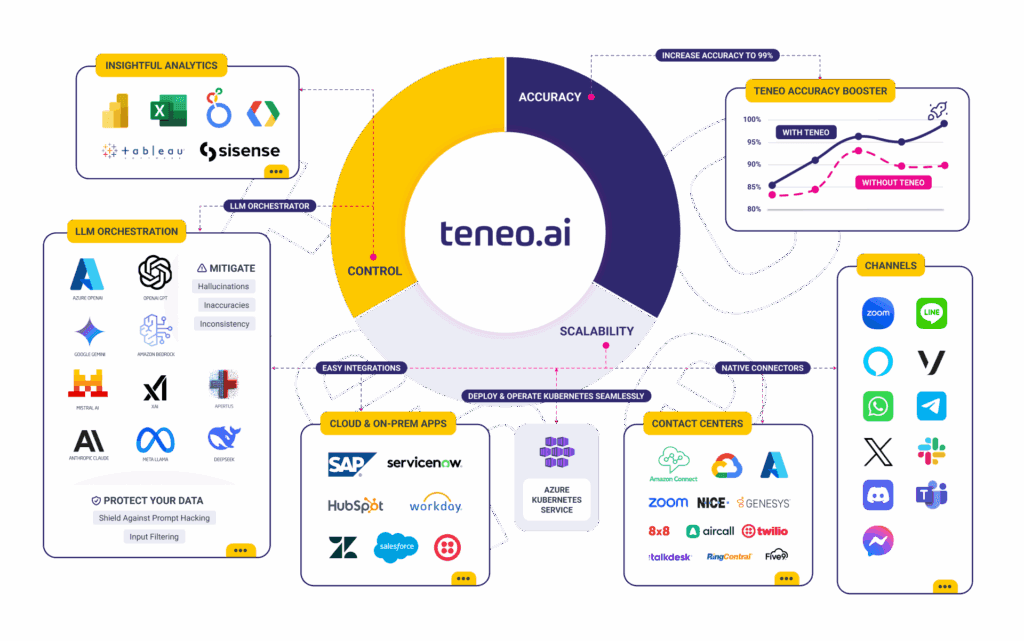
Teneo’s approach focuses on this Orchestration Layer. It’s the traffic controller that ensures the right query goes to the right model while maintaining context, brand voice, and—most importantly—accuracy.
The Evolution of Interaction
| Feature | Legacy Chatbots (2020-2024) | Future AI Agents (2026+) |
| Primary Goal | Deflection (avoiding contact) | Resolution (solving the intent) |
| Context | Session-based (short memory) | Persistent & Hyper-personalized |
| Interface | Text box on a website | Multimodal (Voice AI, Ambient) |
| Logic | Fixed “If/Then” flows | Autonomous Reasoning & Orchestration |
3. Dissolving the Interface: Consistent and Multimodal
The “Text Box” is a transitional technology. In the near future, Conversational AI will become Consistent and Multimodal.
- Multimodal Inputs: You’ll start a conversation via voice in your car, continue it via a gesture on your smart glasses, and finish it with a quick text on your watch.
- Tactile & Visual Feedback: Instead of a paragraph of text, the AI will generate a dynamic, interactive dashboard in real-time to show you why your insurance premium changed, allowing you to “tweak” variables visually. For more on this in practice, see conversational AI for insurance.
- Emotional Intelligence: Using sentiment analysis that actually works, the AI will detect frustration in your micro-inflections and proactively pivot its tone—or seamlessly hand you off to a human with a full summary of the situation.
4. Governance: The “Trust Battery”
As AI takes more actions, the stakes get higher. We can’t have “black box” AI making financial or medical decisions without oversight. The future of Conversational AI is inseparable from AI Ethics and Governance. * Explainability: The AI must be able to “show its work” and explain why it chose a specific path.

- Guardrails: Add business rules that LLMs cannot hallucinate their way around.
- Data Sovereignty: Ensuring that your customer’s sensitive data isn’t being used to train a public model that your competitor might use tomorrow.
You can find more about this on Teneo Security Center.
The Teneo Vision: Your Future, Orchestrated
At Teneo AI, we aren’t just building bots; we are building the infrastructure for the Agentic Enterprise. We believe the future of AI isn’t about replacing humans, but about removing the “robotic” tasks from human lives so we can focus on what actually requires a soul.
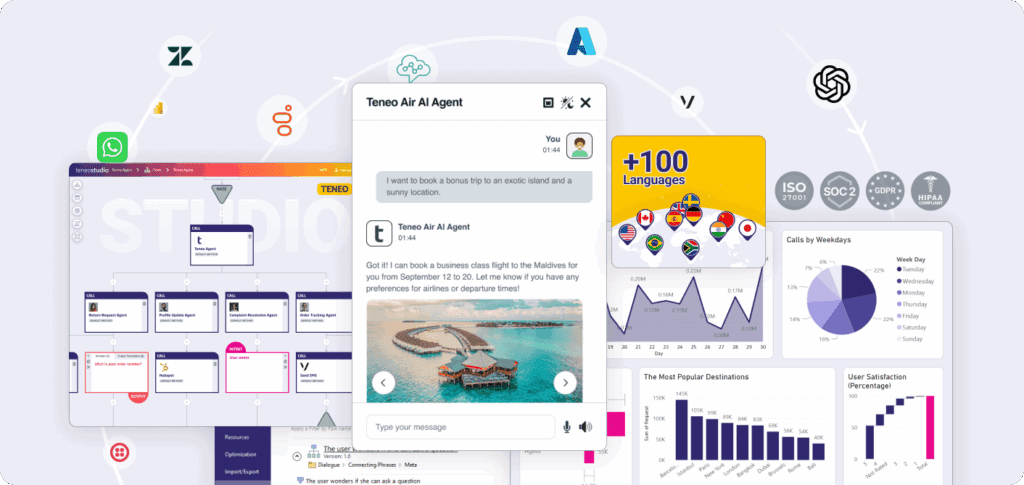
The transition from “Chat” to “Outcome” is happening now. Are you ready to move beyond the text box? Contact us to learn more!
Frequently Asked Questions (FAQ)
What exactly is “Agentic AI” and how does it differ from a chatbot?
A standard chatbot is reactive; it waits for a question and provides a stored or generated answer. Agentic AI is proactive and goal-oriented. It possesses reasoning capabilities, allowing it to break down complex requests into multi-step tasks without a human holding its hand through every step.
Why is “Orchestration” considered the future of enterprise AI?
Most businesses don’t need just one AI model; they need several. Orchestration is the “brain” that decides which model is best for a specific task. It ensures that data remains secure, the brand voice stays consistent, and the user gets the most accurate result by picking the right tool for the job.
Will the future of conversational AI eventually replace human agents?
The goal is augmentation. AI is taking over the “robotic” and repetitive tasks—tracking packages, resetting passwords, or data entry—which allows human agents to focus on high-emotion, high-complexity cases that require genuine empathy and creative problem-solving.
Why is “Outcomes-Driven” AI better for business ROI?
In the past, success was measured by “deflection” (how many people didn’t talk to a human). In the future, success is measured by Resolution. When a customer gets their problem solved in one interaction, customer satisfaction (CSAT) skyrockets, and operational costs drop far more significantly than they do with simple chat deflection. Calculate your ROI with Teneo here.