
The global conversational commerce market is valued at $8.8 billion in 2025 — and growing at 23.7% CAGR through 2030. But for most enterprises, the more relevant number is this: shoppers who interact with conversational AI convert at 4x the rate of those who don’t. This guide covers what conversational AI for ecommerce actually does, which use cases deliver the highest ROI, and how enterprise retailers are deploying it at scale.

What Is Conversational AI for Ecommerce?
Conversational AI for ecommerce refers to AI-powered systems — chatbots, voice agents, and messaging assistants — that engage customers in natural dialogue across the buying journey: from product discovery and personalised recommendations through to purchase, order tracking, and post-sale support.
The key distinction from traditional ecommerce automation is intent understanding. Rather than routing customers through fixed menus or keyword-triggered responses, conversational AI interprets what the customer actually wants — even when they express it ambiguously, across multiple turns, or in their native language.
Key Use Cases: Conversational AI for Ecommerce in Practice
- Order status and tracking: The highest-volume ecommerce enquiry. An AI agent integrates with your OMS and courier APIs to provide real-time, specific updates — eliminating WISMO (Where Is My Order) calls entirely.
- Returns and exchanges: AI agents handle the full return flow: verifying eligibility, generating labels, processing refunds, and offering exchanges — without agent involvement for standard cases.
- Product availability and sizing: Real-time inventory checks, size guide assistance, and cross-sell suggestions delivered conversationally across web, app, and messaging channels.
- Loyalty and account management: Points balance, tier status, redemption options, and account updates — handled autonomously via voice or chat.
- Complaint handling and escalation: Conversational AI handles Tier 1 complaints (delivery delays, damaged goods, wrong items) with empathy, taking action within defined parameters and escalating complex cases to human agents with full context.

Voice AI in Ecommerce: The Channel Most Retailers Are Missing
Most e-commerce conversational AI investment focuses on chat and messaging. But most of Gen-Z shoppers prefer voice over chat — and for complex or high-value issues, voice remains the preferred channel even among younger demographics.
For retail operations with contact centres handling millions of calls annually — holiday peaks, sale periods, new product launches — Teneo’s Voice AI platform provides elastic, enterprise-grade coverage that scales with demand.
Measuring Conversational AI ROI in Ecommerce
The key metrics for enterprise ecommerce conversational AI deployments:
- Conversion rate lift: Shoppers interacting with AI convert vs. without AI
- Containment rate: Percentage of support interactions resolved by AI without human transfer. Target minimum 40%-60% for both chat and voice.
- Cost per resolved interaction: Benchmark your current cost-per-contact against AI-handled interaction costs. Teneo AI has an ROI of $5.60 per call.
- CSAT on AI-handled interactions: Satisfaction should be comparable to (or exceed) human agent scores. Teneo customers achieve double digit CSAT improvement.
- Cart recovery rate: For proactive conversational commerce deployments, track how many abandoned carts are recovered through AI-initiated conversations.
Implementation: Starting Your Ecommerce Conversational AI Programme
- Map your top 10 customer contact reasons. Use call transcripts, chat logs, and CRM data to identify the highest-volume, most repetitive customer queries. These are your first automation targets, usually referred to as the low hanging fruits.
- Start with containment, not deflection. Build AI agents that genuinely resolve queries rather than redirecting customers to FAQs. Resolution drives CSAT; deflection drives frustration.
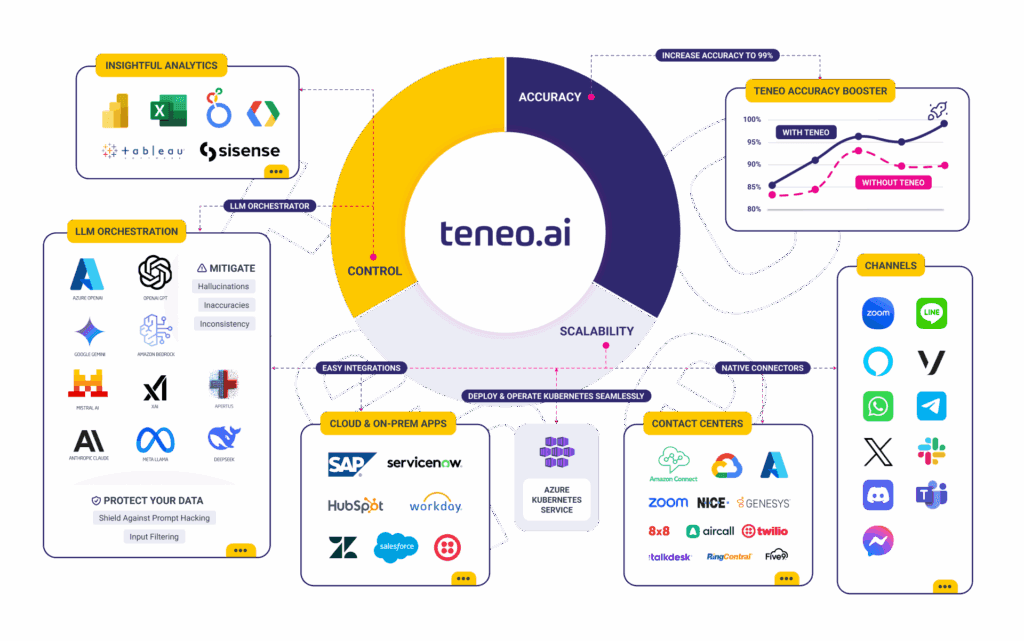
- Integrate with your commerce stack. Connect to your OMS, CRM, returns management system, and inventory platform. Teneo AI can integrate with any system, including Salesforce Commerce Cloud, SAP, Shopify, and any enterprise OMS. See Teneo Integrations for more information.
- Deploy voice and digital in parallel. Don’t ignore the voice channel. Phone interactions remain the primary touchpoint for complex, high-value customer issues — and the AI voice channel delivers the highest containment rates.
- Measure and iterate quarterly. Set baseline metrics before launch. Review containment rate, CSAT, and cost-per-contact monthly.