
In the rush to adopt generative technology, many organizations have fallen into the trap of “Shadow AI”—a fragmented landscape where individual teams deploy disconnected chatbots or use public models without centralized oversight. While these pilots often show initial promise, they rarely survive the transition to production at scale.

A true enterprise AI platform is not a single tool or a “better chatbot.” It is a comprehensive software foundation designed to integrate, automate, and scale artificial intelligence across the entire organization. It serves as the industrial “AI factory” that moves the enterprise from experimental prototypes to reliable, governed, and high-ROI operations.
Defining the Enterprise AI Platform (Beyond the Chatbot)
An enterprise AI platform provides the integrated group of technologies required to design, develop, deploy, and operate AI applications across a multinational business. Unlike consumer AI, which prioritizes ease of use for the individual, the enterprise version prioritizes security, scalability, and contextual awareness.
It acts as the central control plane for the enterprise. Instead of managing AI on a project-by-project basis, IT leaders use the platform to:
- Standardize how models connect to internal data.
- Enforce security protocols across all AI interactions.
- Monitor performance, latency, and costs in real-time.
- Manage the lifecycle of various models (LLMs, SLMs, and deterministic logic).
By providing a unified infrastructure, the platform prevents the “silo effect,” where data is trapped in department-specific tools, and ensures that every AI implementation adheres to the organization’s overarching enterprise architecture for AI.
From Shadow AI to Industrialization: Why Project-Based AI Fails
The primary challenge facing CIOs today is not lack of access to AI models, but the inability to “industrialize” them. When employees use unmanaged public tools, they create significant risks regarding data leakage and compliance violations. Furthermore, siloed prototypes usually hit a ceiling quickly because they lack:
- Deep System Integration: They cannot “act” because they aren’t securely connected to CRM or billing systems.
- Deterministic Control: They rely on probabilistic outputs from Large Language Models (LLMs), which leads to hallucinations in regulated environments.
- Sustainable Economics: The cost of running unoptimized models at high volume can spiral out of control.
Industrializing AI requires moving away from artisanal, one-off builds. The goal is to create a repeatable process where a specialized enterprise co-pilot or agent can be deployed in weeks rather than months, leveraging shared data foundations and pre-built integration frameworks.
The Four Architectural Pillars of an Enterprise AI Platform
For an enterprise AI platform to deliver measurable ROI—such as reducing customer service costs from $6.00 to $0.40 per interaction—it must be built on four foundational pillars.
Pillar 1: Unified Data Governance and Retrieval
Data in large organizations is rarely clean or centralized. An effective platform must handle a “data mesh” approach, making information discoverable across disparate systems while maintaining strict permissions. This is critical for Retrieval-Augmented Generation (RAG) approaches, where the AI’s response is grounded in your knowledge base, rather than general training sets.

Pillar 2: The Hybrid Orchestration Layer
Pure LLM strategies often fail in customer-facing roles because they lack “determinism”—the ability to guarantee a specific answer in a specific situation. A robust platform utilizes a hybrid approach, combining the creative reasoning of LLMs with deterministic linguistic rules. This is what we call Hybrid AI, that ensures 99%+ accuracy in regulated moments while still providing natural, fluid dialogue.
Pillar 3: Infrastructure and Multi-Cloud Strategy
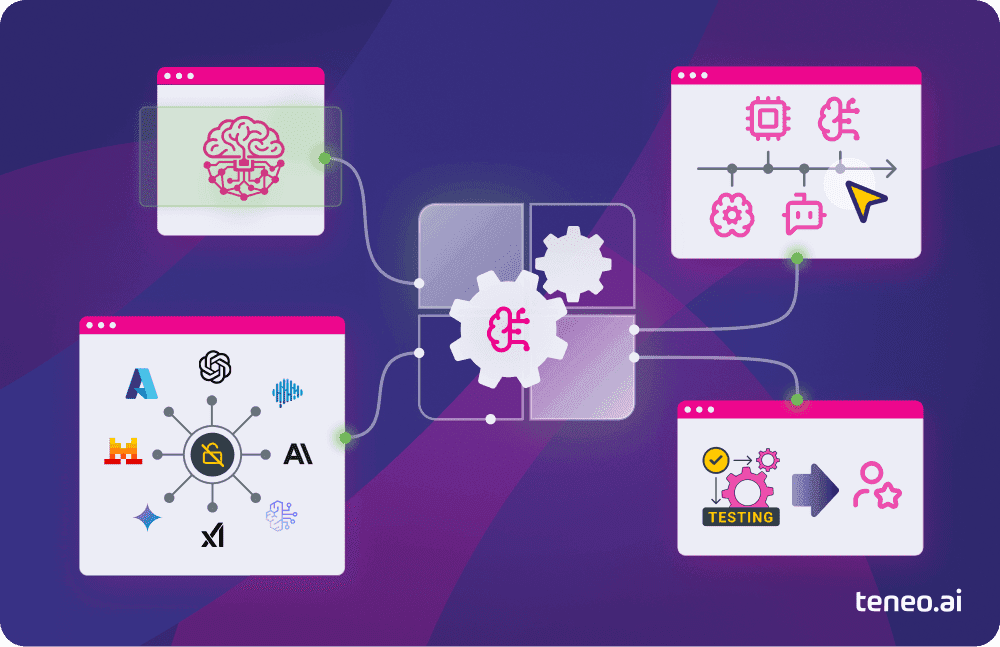
Enterprises must avoid vendor lock-in. A strategic platform remains model-agnostic and cloud-flexible, allowing the organization to swap underlying models (e.g., from OpenAI GPT to Anthropic Claude or Google Gemini) as performance and costs evolve. According to research on navigating data challenges and compliance, the ability to control data residency and infrastructure is a non-negotiable for highly regulated sectors.
Pillar 4: Centralized Governance and Compliance
Governance cannot be an afterthought. The platform must provide full auditability, including transcriptions, decision trails, and role-based access control (RBAC). In banking and finance, this level of oversight is essential to navigate emerging regulatory frameworks for generative AI.
Technical Requirements for Global Scale
Scaling an enterprise AI platform involves more than just adding more servers. It requires a focus on three distinct areas of scalability:
- Intelligence Scalability: The ability to handle complex, multi-turn dialogues across 86+ languages without loss of context or accuracy.
- Development Scalability: Maximizing developer productivity through low-code tools and pre-built agents that can be customized for specific retail and e-commerce use cases.
- Traffic Scalability: Maintaining sub-second latency even during peak traffic spikes, particularly for voice-first interactions where a delay of even four seconds can destroy the customer experience.
Furthermore, legal experts warn about the complexities of key legal issues in generative AI, emphasizing that platforms must have built-in safeguards to prevent the reproduction of copyrighted material or the exposure of sensitive PII (Personally Identifiable Information) to public models.
Integration Strategy: Connecting to the Core Ecosystem
An enterprise AI platform is only as valuable as the actions it can take. Mature platforms move beyond simple API calls to offer deep, certified integrations with the existing technology stack:
- CRM & ERP: Salesforce, SAP, and Microsoft Dynamics.
- Contact Center (CCaaS): Amazon Connect, Genesys Cloud CX, and more.
- Collaboration: Microsoft Teams and Slack.
Instead of one giant “God-bot,” the industry is moving toward a multi-agent orchestration model. In this setup, the platform coordinates specialized agents—one for fraud detection, one for payment processing, and another for knowledge retrieval—ensuring they share context and memory across the customer journey.
Moving Forward: Bridging the Execution Gap
The gap between AI’s potential and its reality in the enterprise is often a result of platform choice. Organizations that treat AI as a series of isolated experiments will continue to struggle with “AI debt” and high maintenance costs. Those that invest in a centralized enterprise AI platform create an environment where innovation is governed, costs are predictable, and global scale is an inherent feature of the architecture.
By prioritizing deterministic control, deep integration, and infrastructure flexibility, IT leaders can move past the hype and deliver a scalable AI strategy that provides sustainable value across every business function.
Ready to see an enterprise-grade platform in action?
Request a Demo to learn how to industrialize your AI strategy.