

Customer expectations have changed fast. People want immediate answers, natural conversations, and seamless support across chat, voice, messaging, and mobile. That is exactly why conversational AI customer service has become a priority for modern enterprises.

At Teneo, we see conversational AI as more than a chatbot bolted onto a support flow. Done right, it becomes the intelligence layer behind faster resolutions, lower service costs, and better experiences across every channel. Our platform is built to help enterprises automate customer service with AI agents, voice automation, low-code tooling, and integrations designed for real contact center environments.
What Is Conversational AI Customer Service?
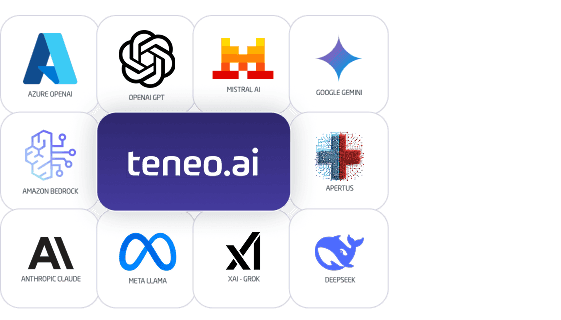
Conversational AI customer service is the use of AI technologies such as natural language processing (NLP), machine learning, and large language models (LLMs) like Google Gemini to understand customer intent and respond in natural language across support channels. It is used in chat, messaging, voice, and self-service experiences to resolve questions, complete tasks, and escalate when needed.
The difference between basic automation and true conversational AI is flexibility. Traditional rule-based bots only work well when customers follow a narrow script. Conversational AI can handle variation in phrasing, context, and intent, which is essential in real customer service where no two conversations are exactly alike. That is why it is importatn to deliver conversational AI with orchestration, knowledge access, and enterprise integrations rather than limiting automation to simple FAQs.
Why It Matters Now
Customer service teams are under pressure from every angle: higher contact volumes, rising labor costs, multilingual demand, and expectations for 24/7 support. Businesses cannot solve all of that by hiring alone.
Conversational AI customer service helps enterprises scale support without sacrificing quality. It can answer common questions instantly, route requests intelligently, personalize responses using customer and system data, and pass complex cases to human agents with context intact.
In other words, conversational AI is no longer a nice-to-have. It is becoming the operating model for efficient, always-on service.
How Conversational AI Works in Customer Service
A strong conversational AI customer service solution typically brings together several layers.
First, it listens. In chat, that means processing typed language. In voice, that means speech recognition and spoken language understanding. Next, it interprets what the customer actually wants by identifying intent, context, and relevant entities such as order number, account type, or service issue. Then it decides what action to take: answer from a knowledge source, trigger a workflow, authenticate the user, pull data from a CRM, or escalate to a live agent. Finally, it responds in a natural, brand-consistent way.
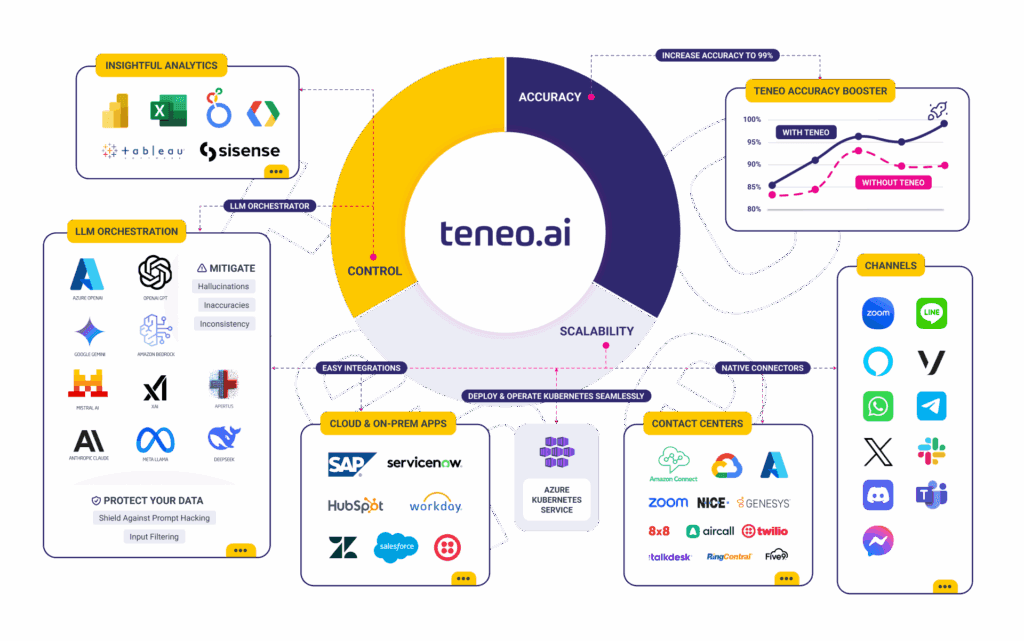
At Teneo, we also put a lot of emphasis on control. Our platform combines conversational AI and generative AI with low-code tooling, real-time testing, and integrations so enterprises can automate safely and accurately rather than relying on a black box.
Benefits of Conversational AI Customer Service
The biggest win is speed. Customers get answers immediately instead of waiting in queue. But the value goes much further.
It improves consistency because every customer gets accurate, on-brand responses across channels. It improves scalability because AI agents can handle high volumes at the same time, including peaks caused by seasonality or outages. It also improves efficiency by offloading repetitive work from human agents, so teams can focus on sensitive, complex, or high-value conversations. These benefits are echoed across competitor content, which highlights faster service, multilingual support, personalization, and better agent productivity.
For enterprises, the business case is strong. Teneo states that its customer service automation platform is designed to deliver instant, accurate, and personalized service across chat, messaging, web, mobile, voice, and social while orchestrating back-office processes to resolve requests in one interaction.
Best Practices for Implementation
The first step is not choosing a bot. It is choosing the right customer journeys. Start with interactions that are repetitive, measurable, and tied to clear outcomes such as containment, first-contact resolution, or lower average handle time. These are usually referred as the low hanging fruits.
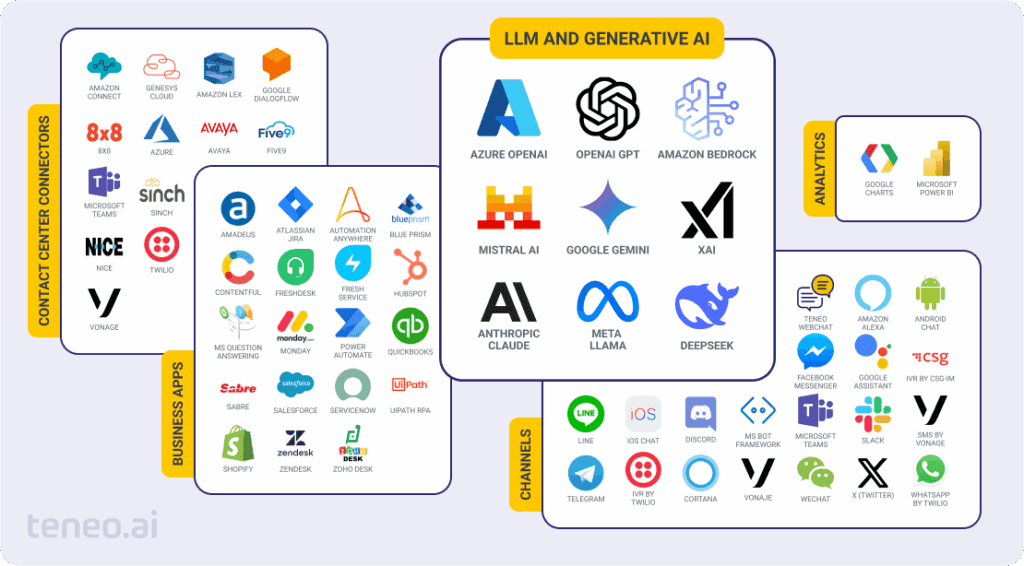
Second, connect AI to the systems that matter. Conversational AI is far more useful when it can read and write data across CRMs, contact center platforms, order systems, and knowledge bases. Teneo can be integrated seamlessly with existing CCaaS environments, public APIs, and a composable architecture as part of our enterprise approach.
Third, design for human handoff. Great automation is not about trapping the customer in self-service. It is about resolving what can be resolved and passing on the rest with full context.
Fourth, measure relentlessly. Accuracy, containment, resolution rate, transfer rate, deflection, and customer satisfaction should all be tracked continuously.
Why Teneo for Conversational AI Customer Service
At Teneo, we build for enterprise customer service from the ground up. Our platform is designed to automate current contact center environments with conversational AI, generative AI, AI agents, and voice automation while giving teams the control they need over accuracy, cost, and scalability. We also support no-code, low-code, and pro-code development so both business and technical teams can move faster.
That matters because enterprise customer service is not just about answering questions. It is about connecting knowledge, systems, workflows, and channels into one seamless service operation. That is where we focus.
FAQs
What is conversational AI customer service?
It is the use of AI to understand customer language and provide automated support across chat, voice, messaging, and self-service channels.
How is conversational AI different from a traditional chatbot?
Traditional chatbots follow fixed rules. Conversational AI can understand natural language, handle more variation, and respond with greater context and flexibility.
What are the main benefits of conversational AI customer service?
The biggest benefits are faster responses, 24/7 availability, lower service costs, better scalability, and improved agent efficiency.
Can conversational AI work for voice as well as chat?
Yes. Modern platforms support both chat and voice, including conversational IVR, speech recognition, and voice automation.
What should enterprises look for in a conversational AI platform?
Look for strong language understanding, enterprise integrations, omnichannel support, analytics, testing, security, and seamless handoff to human agents.
Conclusion
Conversational AI customer service is changing how enterprises support customers. It helps teams respond faster, automate smarter, and deliver more natural service across every channel. But the real value comes when conversational AI is connected to business systems, designed around real customer journeys, and managed with enterprise-grade control.
That is exactly where we focus at Teneo. We help enterprises turn AI from a support add-on into a scalable, high-accuracy customer service engine built for voice, chat, and the modern contact center.