
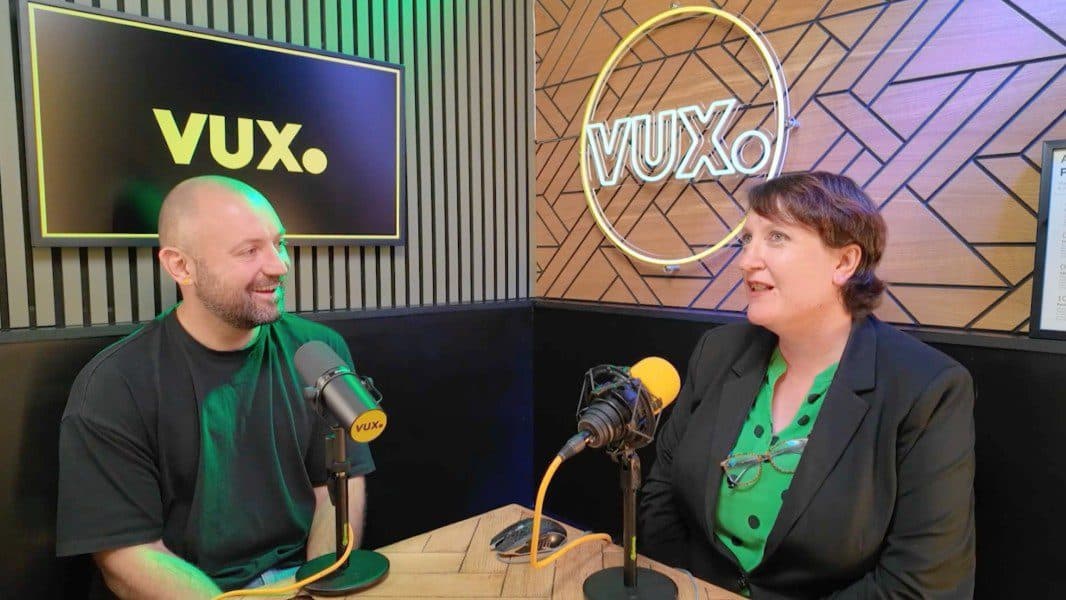
When everyone is suddenly “agentic,” it’s easy for the term to lose meaning. In the recent VUX World episode “What is agentic AI? Inside Teneo’s real-world automation approach”, our own Anne Jenkins, VP of Solution Architecture at Teneo AI, joins host Kane Simms to unpack what’s real, what’s hype, and how enterprises can actually use agentic AI today.
This article is our point of view on that conversation—and how it connects to the way we build AI Agents on the Teneo platform.
From Buzzword to Blueprint: Defining Agentic AI
The episode starts from a simple problem: “agentic AI” is everywhere but rarely defined. Anne draws a clear line between marketing labels and real capability.
In our world, an AI agent is not just a chat interface. It is:
- Goal-driven – works towards explicit business outcomes (e.g., “resolve the billing issue,” “complete the loan pre-approval”).
- Context-aware – understands who the user is, what’s already happened, what systems are involved.
- Action-capable – can call APIs, orchestrate workflows, and update back-end systems, not just generate text.
- Stateful – keeps track of a conversation and business process over time, across channels.
That’s the core of agentic AI as we see it: AI that can think, reason, and act in service of a business goal, while staying under enterprise-grade control. You can explore more about this on the Teneo Agentic AI page.
Why We Don’t Believe in “LLM-Only” Automation
A major theme of the podcast is the tension between “Just throw a giant LLM at the problem” vs. “Compose a solution using the right tool for the right job”.
Anne explains why Teneo’s hybrid AI approach—combining our deterministic NLU and TLML™ with large language models (LLMs)—more reliably delivers production-grade automation than pure LLM stacks.
On the Teneo Platform, that looks like:
- Unmatched NLU and TLML™ providing up to 99% understanding accuracy for complex customer intents.
- Intelligent LLM orchestration to inject fluency, reasoning, and summarization where it adds value—while controlling cost and latency (up to 98% reduction in GenAI costs through orchestration and approximation).
- Deterministic guardrails handling safety, compliance, and escalation—with LLMs sitting inside a governed, observable framework instead of “freestyling” in production.
The result is genuinely agentic behavior—agents that can act, not just answer, without sacrificing predictability.
For a deeper look at how this lands in real deployments, our Why Teneo page outlines how we pair agentic behavior with enterprise security, observability, and governance.
Real-World Automation: Where Agentic AI Delivers Value
One thing we loved about the VUX World conversation: it’s grounded in real use cases, not abstractions. Anne walks through scenarios where agentic AI is already changing how enterprises operate.
Contact Center & Customer Service
Agentic AI shines in environments where:
- Conversations are complex and multi-step
- Multiple systems need to be orchestrated
- Outcomes matter more than “answering a FAQ”
With Teneo Contact Center Automation, enterprises reach up to 99% self-service across channels—voice, chat, and digital—while freeing human agents for higher-value work.
Our AI Agents can:
- Authenticate users, fetch CRM data, and take actions
- Manage full processes like returns, billing disputes, and order changes
- Escalate intelligently with summaries, sentiment, and next-best-actions ready for the human agent
You can explore concrete examples in our contact center AI guides and use cases.
Healthcare & Regulated Environments
The same agentic principles apply in regulated industries like healthcare, where governance and context are non-negotiable.
Using Teneo, organizations are:
- Automating appointment scheduling and triage
- Supporting patients and clinicians 24/7 via voice and chat
- Maintaining strict compliance while improving access to care
Our healthcare AI articles and Medtronic case study show how conversational IVR evolved into secure, agentic AI that modernizes patient and clinician experiences.
Context Engineering, State Management, and Design – The Unseen Work
The podcast also dives into the “unsexy” side of agentic AI: context engineering, state management, and experience design.
On Teneo 8, we’ve made that work:
- Visual and composable – The AI Agent Builder lets teams define goals, skills, tools, and data connections in a no-code environment, then refine with low-code where needed.
- Reusable at scale – Skills and flows can be reused across agents, channels, and regions, so you’re not reinventing the wheel for every use case.
- Observable & improvable – Because state is explicit and structured, you can analyze agent behavior, tune prompts, update business logic, and iterate safely.
This is what turns a “cool demo” into a sustainable AI workforce.
How to Start Your Agentic AI Journey with Teneo
Toward the end of the episode, Anne talks about how businesses should actually adopt AI: start focused, prove value, and scale with intention—not by chasing headlines.
If you’re just getting started:
- Pick one high-value journey – A specific process where automation would materially move the needle (e.g., payment arrangements, appointment scheduling, password resets).
- Define clear success metrics – Containment rate, cost-per-contact, NPS, operational savings, or time-to-resolution.
- Use Agentic AI where it matters – Let AI Agents take end-to-end ownership of that journey, with deterministic guardrails and human oversight.
- Scale horizontally – Once the first agent is working, replicate patterns to new journeys, channels, and regions.
On this website, you can dive deeper into our platform, explore use cases, and see how enterprises are already scaling their AI workforce.
Agentic AI isn’t a label we slap on our product.
It’s the design philosophy behind how we build, orchestrate, and govern AI Agents for real-world automation.
The VUX World conversation with Anne Jenkins is a great entry point into that philosophy—our platform, case studies, and learning hub show how it plays out in production every day. Contact us to learn more!