

For large enterprises, adopting new technology isn’t just about innovation; it’s about managing risk while driving measurable ROI. The voice AI market is exploding, projected to become a $45 billion industry by 2025, with Gartner predicting it will reduce contact center labor costs by $80 billion globally by 2026.

Yet, the promise of massive ROI is tempered by significant risk. Many AI initiatives fail to deliver, with the IBM Institute for Business Value finding that enterprise AI projects achieve a mere 5.9% ROI on average. This makes choosing the right platform a high-stakes decision that requires careful evaluation.
This buyer’s guide cuts through the hype to provide a data-driven comparison of the top 10 voice AI agents for enterprise contact centers in 2026. We focus on what truly matters for large-scale deployments: accuracy, compliance, scalability and a proven track record. We will explore the unique challenges of enterprise voice AI, provide a framework for evaluating vendors, and review the most established solutions on the market to help you make a confident choice.
What Are Voice AI Agents?
A voice AI agent is a sophisticated software program that uses artificial intelligence, including Natural Language Processing (NLP) and speech recognition, to understand and respond to human speech in real-time. Unlike traditional Interactive Voice Response (IVR) systems that rely on rigid, pre-programmed menus, voice AI agents can handle complex, natural conversations, understand user intent, and even perform tasks autonomously.
These agents can be categorized into three main types:
- Autonomous Voice Agents: Handle entire conversations without human intervention. They are best for high-volume, repetitive tasks like order status checks, appointment scheduling, or simple FAQs.
- Agent Assist (or Copilots): Work alongside human agents, providing real-time guidance, suggested responses and compliance reminders. They augment human performance rather than replacing it.
- Hybrid Voice Agents: Combine both approaches, where an AI agent might handle the initial part of a call (e.g., identity verification) before seamlessly transferring to a human agent with full context.
How to Choose the Right Voice AI Agent
Selecting the right platform requires a strategic framework that aligns with your business priorities. Use this evaluation framework to assess potential vendors:
| Requirement | Why It Matters for Large Enterprises |
| Extreme Scalability | Must handle millions of concurrent calls across global data centers without performance degradation. Failure can impact entire markets. |
| Robust Security & Compliance | Must meet stringent regulations like GDPR, HIPAA and SOC 2. Data breaches can result in multi-million dollar fines and loss of customer trust. |
| Legacy System Integration | Must seamlessly connect with complex, often decades-old on-premise systems (e.g., mainframes, custom CRMs) that are common in large organizations. |
| Vendor Stability & Support | The vendor must be a financially stable partner with a dedicated enterprise support model capable of providing 24/7 global assistance. |
| Total Cost of Ownership (TCO) | Beyond per-minute rates, what are the costs for implementation, training, maintenance, and custom integration? A lower initial cost can often hide significant long-term expenses. |
| NLU Accuracy | The core ability of the AI to understand user intent correctly. Low accuracy leads to poor customer experience and failed automation. |
Comparison of the Top 10 Voice AI Agents for 2026
| Vendor | Best For | Key Feature | Pricing Model |
| Teneo.ai | Regulated industries needing max accuracy | Hybrid AI with 99% accuracy | Custom |
| Google CCAI | Companies standardized on Google Cloud | Superior speech recognition | Per-Second |
| Amazon Connect | Businesses with strong AWS expertise | Serverless, scalable architecture | Pay-as-you-go |
| IBM Watson | On-premise or hybrid cloud needs | Advanced voice biometrics | Per-User |
| Microsoft | Companies invested in Dynamics 365 | Deep integration with Microsoft ecosystem | Bundled |
| Genesys Cloud CX | Enterprises seeking a single, integrated platform | Deep omnichannel orchestration | Per-User |
| Replicant | Mid-size enterprises with defined use cases | Industry-specific conversation design | Custom |
| Nuance Mix | Healthcare organizations | Deep medical domain expertise | Custom |
| NICE CXone | Organizations prioritizing agent coaching | Extensive agent performance analytics | Per-User |
| Five9 | Current Five9 customers | Deep CCaaS ecosystem integration | Per-User |
The 10 Proven Voice AI Platforms for Large Enterprises
Here is our detailed breakdown of the top voice AI platforms for enterprise contact centers in 2026.
Teneo.ai: The Hybrid AI Leader for Enterprise Scale and Accuracy
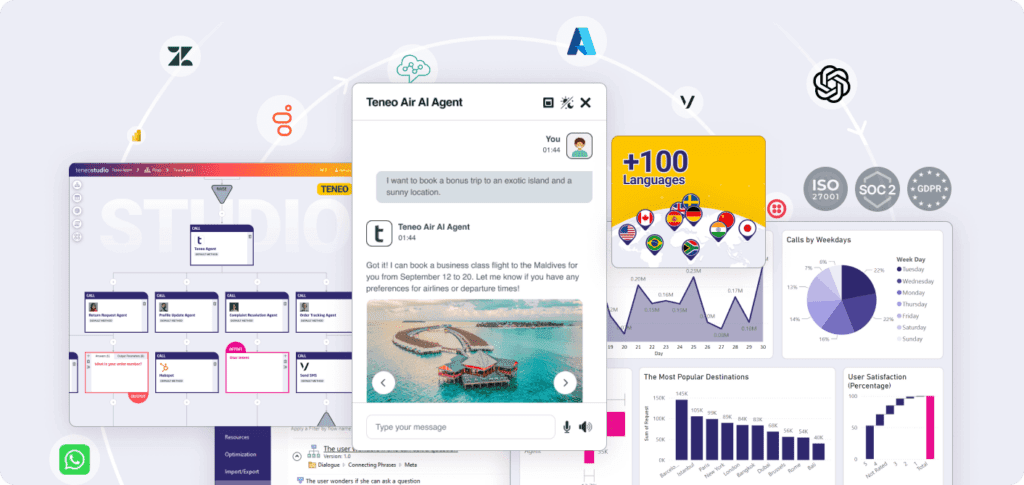
Teneo.ai leads the market with an 95% accuracy rate. This is achieved through its patented Hybrid AI architecture, which combines the power of large language models (LLMs) with the control and determinism of a linguistic modeling language. This delivers the stringent compliance and auditability that large enterprises demand.
- Key Differentiator: Teneo’s patented Hybrid AI approach provides a deterministic layer that avoids the unpredictability of pure LLM solutions, making it the safest choice for high-stakes, regulated environments.
- Pros: Market-leading accuracy, compliance-first design, no vendor lock-in (multi-LLM support), deep integration capabilities with legacy systems.
- Cons: May be more than required for simple, non-regulated use cases where lower accuracy and hallucinations is acceptable.
- Pricing: Custom enterprise pricing. Contact for a quote.
- Best For: Large, risk-averse enterprises in any industry, including finance, healthcare, telecom and more that require the highest levels of accuracy, compliance and reliability.
Google Contact Center AI (CCAI)
Google’s CCAI leverages the power of its global cloud infrastructure and advanced speech recognition technology. It is a strong contender for companies already invested in the Google Cloud ecosystem.
- Key Differentiator: Superior speech recognition and native integration with Google’s vast ecosystem of AI and data analytics tools.
- Pros: Excellent speech-to-text accuracy, strong analytics, native Google Cloud integration.
- Cons: In Teneo’s benchmark, Google Dialogflow achieved a 76% accuracy score, a significant performance gap for complex enterprise use cases. It can also be less flexible when integrating with non-Google systems.
- Pricing: Starts at $0.007 per second of speech for Dialogflow CX.
- Best For: Companies standardized on Google Cloud Platform that have less complex intent libraries.
Amazon Connect with Lex
Amazon Connect with Lex offers unmatched scalability and a flexible, pay-as-you-go model, making it a popular choice for businesses with strong AWS expertise.
- Key Differentiator: A serverless, highly scalable architecture that is deeply integrated with the AWS ecosystem.
- Pros: Serverless architecture, tight AWS integration, rapid deployment, pay-as-you-go pricing.
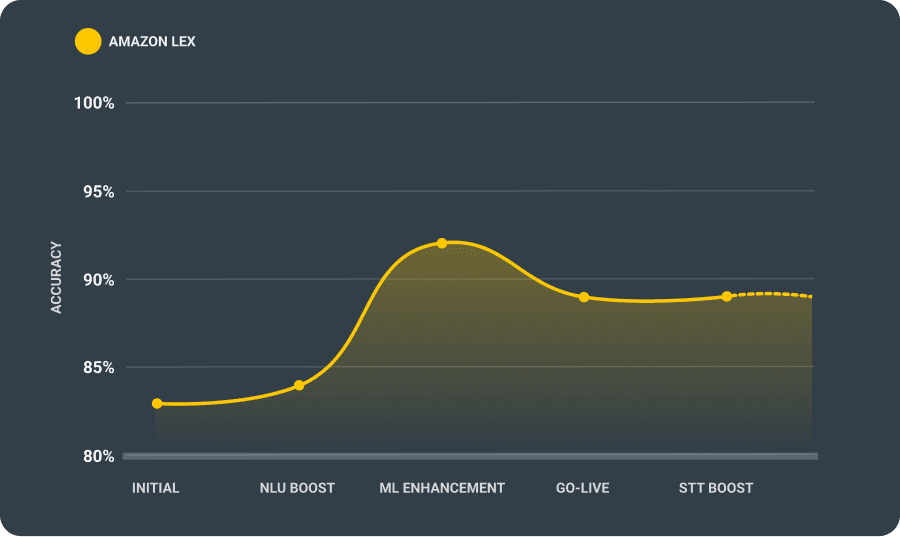
- Cons: In Teneo’s benchmark, Amazon Lex achieved an 89% accuracy score, making it a strong performer but still trailing the market leader. The self-service nature of AWS can also require significant in-house expertise to manage and optimize.
- Pricing: Pay-as-you-go, starting at $0.004 per message for Lex.
- Best For: Businesses with strong AWS expertise and variable call volumes.
IBM Watson Assistant
IBM Watson Assistant has a long history in the enterprise AI space and is known for its strong security features and hybrid deployment options.
- Key Differentiator: Advanced voice biometrics and flexible hybrid deployment options (public cloud, private cloud, or on-premise).
- Pros: Strong enterprise security features, hybrid deployment flexibility, advanced voice biometrics.
- Cons: In Teneo’s benchmark, it scored 81% for accuracy, indicating potential challenges with more nuanced user intents. It can also be more complex to configure and maintain compared to newer platforms.
- Pricing: Starts at $140/month for 1,000 monthly active users.
- Best For: Highly regulated industries with a need for on-premise or hybrid cloud deployments.
Microsoft Dynamics 365 Customer Service AI
Microsoft’s solution is deeply integrated into the Dynamics 365 and Azure ecosystems, making it a natural choice for companies heavily invested in Microsoft products.
- Key Differentiator: Seamless, out-of-the-box integration with Microsoft Dynamics CRM and Azure services.
- Pros: Tight integration with Microsoft products, strong partner ecosystem, predictive AI capabilities.
- Cons: Less effective as a standalone solution outside the Microsoft ecosystem; its value is intrinsically tied to Dynamics 365 adoption.
- Pricing: Typically bundled with Dynamics 365 Customer Service Enterprise licenses.
- Best For: Companies heavily invested in the Microsoft Dynamics and Azure ecosystems.
Genesys Cloud CX
Genesys is a long-standing leader in the contact center space. Its built-in AI capabilities are an extension of its core CCaaS platform, offering a single, integrated solution.
- Key Differentiator: Deep omnichannel orchestration, allowing for seamless customer journeys across voice, chat, email, and social channels.
- Pros: Extensive agent management tools, large partner ecosystem, unified platform for all contact center operations.
- Cons: Can be a monolithic solution; replacing the native bot layer with a more advanced engine like Teneo is often necessary for complex automation that demands higher accuracy.
- Pricing: Starts at $75 per user per month.
- Best For: Enterprises seeking a single, integrated platform for all contact center operations.
Replicant
Replicant is a purpose-built platform for customer service automation, focusing on resolving customer issues quickly and efficiently with a library of pre-built components.
- Key Differentiator: A thinking engine that can resolve complex, multi-intent customer issues end-to-end, with a library of pre-built components for fast deployment.
- Pros: Industry-specific conversation design, robust intent recognition, strong analytics dashboard.
- Cons: May not be as flexible as platform-based solutions for highly custom workflows that fall outside its pre-built models.
- Pricing: Custom enterprise pricing.
- Best For: Mid-size enterprises with defined use cases in supported industries (e.g., retail, insurance, and travel).
Nuance Mix
Now part of Microsoft, Nuance has deep expertise in voice AI, particularly in healthcare, built on decades of experience in speech recognition technology.
- Key Differentiator: Deep domain expertise in healthcare and other regulated industries, with a strong focus on voice biometrics and security.
- Pros: Excellent medical terminology understanding, strong voice biometrics, HIPAA-compliant architecture.
- Cons: Can be more expensive than other solutions, and its focus on specific verticals may mean less flexibility for general-purpose use cases.
- Pricing: Custom enterprise pricing.
- Best For: Healthcare organizations and other large enterprises requiring specialized compliance and terminology.
NICE CXone with Enlighten AI
NICE CXone is a comprehensive cloud contact center platform with a strong focus on workforce optimization and analytics, powered by its Enlighten AI engine.
- Key Differentiator: A comprehensive Workforce Optimization (WFO) and analytics suite integrated with AI to improve agent performance and customer satisfaction.
- Pros: Extensive agent performance analytics, integrated quality management, predictive behavioral routing, and real-time agent guidance.
- Cons: AI capabilities are tightly bundled with the broader CXone platform, making it less ideal as a standalone voice AI solution.
- Pricing: Starts at $100 per user per month.
- Best For: Organizations prioritizing quality management, agent coaching and performance analytics.
Five9
Five9 is a leading cloud contact center provider with a comprehensive suite of tools for inbound, outbound, and blended operations, now with integrated AI capabilities.
- Key Differentiator: A leading cloud contact center provider with a comprehensive suite of tools for inbound, outbound, and blended operations.
- Pros: Deep CCaaS ecosystem integration, extensive telephony capabilities, strong supervisor monitoring tools.
- Cons: AI is an add-on to their core offering, not a standalone specialty. May not have the same depth in AI-specific features as specialized vendors.
- Pricing: Starts at $149 per user per month.
- Best For: Current Five9 customers looking to add AI voice capabilities within their existing ecosystem.
Frequently Asked Questions (FAQ)
What is the best voice AI agent for large enterprises?
For large enterprises in regulated industries, Teneo.ai is the top choice due to its market-leading 99% accuracy, hybrid AI architecture for compliance, and proven success with global brands. For companies standardized on a specific cloud provider, Google CCAI or Amazon Connect are strong alternatives.
How much do voice AI agents cost?
Pricing models vary significantly. Some vendors charge per minute or per second (e.g., Google), while others charge per user per month (e.g., Genesys, Five9). Enterprise solutions are often custom-priced based on volume and complexity. Always consider the Total Cost of Ownership (TCO), including implementation and maintenance fees.
Which voice AI platform has the highest accuracy?
Based on independent benchmarks using the industry-standard BANKING77 dataset, Teneo.ai has the highest NLU accuracy at +95%.
What is the ROI of implementing voice AI?
The ROI can be significant, with benefits including reduced labor costs, increased first-call resolution rates, shorter handle times, and improved customer satisfaction (CSAT). Teneo.ai offers an Enterprise ROI Calculator to model potential savings.
How do voice AI agents integrate with CCaaS platforms?
Most leading voice AI platforms offer pre-built integrations with major CCaaS providers like Genesys, Amazon Connect and NICE CXone. They also provide robust APIs for custom integrations with homegrown or legacy systems.
Are voice AI agents replacing human agents?
No. Voice AI agents are augmenting human agents, not replacing them. They handle repetitive, high-volume tasks, allowing human agents to focus on more complex, high-value, and empathetic interactions that require a human touch.
What compliance requirements do voice AI agents need?
Enterprise-grade voice AI agents must meet stringent regulations like GDPR for data privacy, HIPAA for healthcare information and SOC 2 for security and availability. Ensure any vendor you choose can provide third-party audit reports.
What are the risks of using voice AI in contact centers?
The primary risks include poor customer experience due to low accuracy, data security and compliance breaches, and the inability to handle complex or emotional conversations. Choosing a proven, enterprise-grade platform with strong guardrails is critical to mitigate these risks.
How long does it take to implement a voice AI agent?
A typical deployment timeline for a large-scale voice AI project is 3 to 6 months, including discovery, a pilot program and a phased rollout.
What is the difference between a voice AI agent and an IVR?
An IVR (Interactive Voice Response) uses a rigid, touch-tone or simple command-based menu. A voice AI agent uses natural language processing to understand and respond to complex, conversational speech, allowing for much more natural and effective interactions.
Conclusion: The Safest Choice for Enterprise Scale
While many platforms offer voice AI capabilities, the unique demands of large enterprises—scalability, security, compliance, and reliability—narrow the field considerably. In a market where the average AI project ROI is often low and NLU performance varies widely, a proven solution with a track record of success at the highest level is paramount.
Teneo.ai, with its patented Hybrid AI architecture and market-leading +95% accuracy validated on a live customer, stands out as the safest and most reliable choice for large enterprises seeking to deploy voice AI without compromising on compliance or customer trust.
To learn more about how Teneo can meet your specific enterprise requirements, request a personalized demo or use our Enterprise ROI Calculator to model your potential savings.