
Lately, I’ve been rethinking AI decision making. One approach that resonates with me is system-centric orchestration.
Most organizations don’t have a decision problem; they have a communication problem.
They’ve already invested heavily in policy engines, rules systems and decision-making logic. These systems evaluate eligibility, enforce thresholds and apply regulatory rules with precision. The decisions are already being made, correctly. But when it comes to communicating those decisions to customers, things break down.
Why? Because AI is being asked to think when it should be asked to execute.
This is where Policy-Driven Orchestration (or what we call Backend Decision Design) changes the model. Instead of pushing decision-making into a generative AI layer, the backend remains the source of truth. A service returns a deterministic, authoritative outcome. The AI’s role is not to interpret policy or calculate eligibility, but to orchestrate the experience: route the decision, explain it clearly and execute the next step.
This enforces a critical principle: control before cognition.
When generative AI is used to interpret policy or infer rules, the risks are immediate and material (hallucinated outcomes, inconsistent decisions, regulatory exposure and ultimately a broken customer experience). These are not edge cases; they are predictable failure modes of model-centric architectures.
Probabilistic models will “probably get it right”, which also means they will “probably get it wrong” at least some of the time.
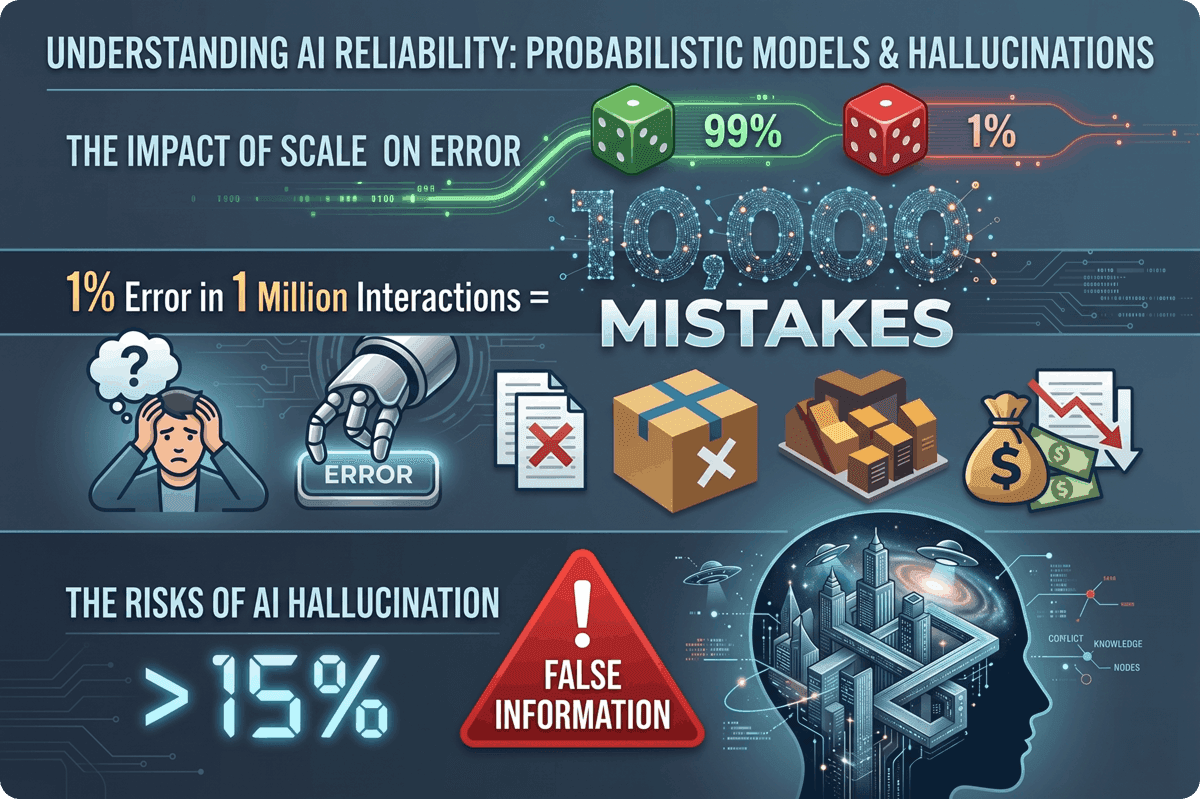
Even if an LLM (or worse an LAM that acts based on probabilistic models) gets it wrong 1% of the time in a million interactions, you’ve now exposed 10,000 errors to your customers.
What is the cost of getting 10,000 decisions or actions wrong in your business? The scarier part is that most studies indicate GenAI “even top-performing models show >15% hallucination rates in reasoning tasks.” (See, LLM Hallucination Statistics 2026: Hidden Risks Now • SQ Magazine).
System-centric architecture takes a different approach. It relies on your existing backend systems to make decisions and return structured responses. From there, a deterministic orchestration layer ensures those decisions are communicated clearly, consistently and compliantly.
The result is what enterprises actually need: 100% policy alignment, explainable AI and safe automation at scale with faster containment and lower operational cost.
At its simplest, the difference is this:
- An LLM-first system says, “Let me think about whether you deserve a refund.”
- A system-centric approach says, “The decision has already been made. I’ll explain it clearly.”
That’s the shift from model-centric AI to system-centric control.
Because in production, failure isn’t optional, but chaos is.

Howard Leary
Howard Leary II is a Lead Solutions Architect at Teneo.ai with decades of experience in contact center technology, including conversational and Agentic AI for Enterprises. He helps global organizations design scalable, policy-driven automation that balances innovation with control, compliance and performance, turning complex AI into practical, high-impact business outcomes.