

Are you looking for an LLM Webinar? We are excited to announce that our insightful webinar, “Top 5 Challenges of LLMs for Enterprises and How to Solve Them,” is now available on demand!
As large language models (LLMs) like GPT-4o continue to reshape the enterprise landscape, understanding the challenges they present—and how to overcome them—is more important than ever. This webinar delves into the most pressing issues faced by organizations when implementing LLMs, offering practical solutions to ensure your business can fully harness their power.
Whether you’re dealing with data privacy concerns, scaling issues, or the complexities of model integration, this session provides the guidance you need to navigate these challenges effectively. There is also a blog post covering this topic, which can be found here.
Watch the webinar now and equip your team with the knowledge to successfully implement LLMs in your enterprise!
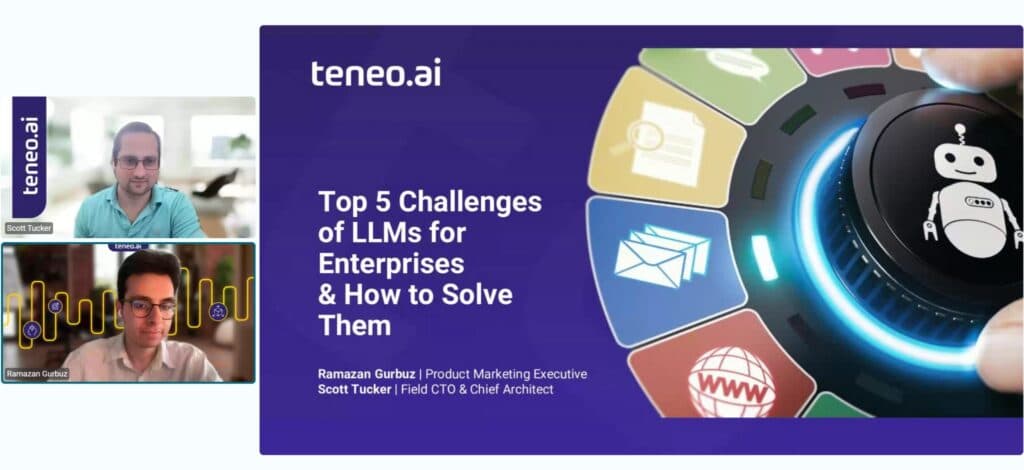
Webinar Outline
00:00 – Introduction
04:29 – What are LLMs?
07:05 – Top 5 Challenges of LLMs for Enterprises
22:20 – How to solve the Top 5 Challenges
37:00 – Listen to a real use-case with Teneo
38:00 – Questions and Outro
Watch on Demand
You can watch the webinar on demand here: Top 5 Challenges of LLMs for Enterprises and How to Solve Them
FAQs
What are the top 5 challenges enterprises face when implementing large language models (LLMs) and how can they be solved?
Enterprises face five critical challenges when implementing LLMs, each with proven solutions: (1) Data Privacy and Security: Challenge – Protecting sensitive enterprise data when using cloud-based LLMs. Solution – Deploy on-premises or private cloud LLM solutions with enterprise-grade encryption and access controls, (2) Accuracy and Reliability: Challenge – LLMs generating incorrect or inconsistent information. Solution – Implement robust training data curation, fine-tuning with enterprise-specific data, and comprehensive testing frameworks, (3) Integration Complexity: Challenge – Connecting LLMs with existing enterprise systems and workflows. Solution – Use platforms with pre-built connectors and APIs designed for enterprise integration, (4) Cost Management: Challenge – Unpredictable and potentially high operational costs. Solution – Implement usage monitoring, optimization strategies, and hybrid deployment models balancing cost and performance, (5) Compliance and Governance: Challenge – Meeting regulatory requirements and ethical AI standards. Solution – Deploy LLMs with built-in compliance features, audit trails, and governance frameworks. Organizations addressing these challenges achieve 85-95% successful LLM implementation rates and 300-500% ROI within 18-24 months.
How can enterprises overcome LLM accuracy and reliability challenges in mission-critical applications?
Enterprises can overcome LLM accuracy and reliability challenges through systematic approaches:
Accuracy Enhancement Strategies: (1) Domain-Specific Training: Fine-tune LLMs with high-quality, enterprise-specific data ensuring accuracy for industry terminology and business processes, (2) Retrieval-Augmented Generation (RAG): Combine LLMs with enterprise knowledge bases providing real-time access to accurate, up-to-date information, (3) Multi-Model Validation: Use multiple LLM approaches and cross-validation techniques to verify response accuracy and consistency, (4) Human-in-the-Loop: Implement review processes for critical decisions with human oversight and approval workflows.
Reliability Assurance: (1) Comprehensive Testing: Extensive validation across diverse scenarios, edge cases, and business contexts before production deployment, (2) Performance Monitoring: Real-time tracking of LLM accuracy, response quality, and business impact metrics with automated alerts, (3) Fallback Mechanisms: Intelligent escalation to human experts when LLM confidence levels fall below acceptable thresholds, (4) Continuous Learning: Regular model updates and retraining based on new data and performance feedback.
Quality Control: (1) Output Validation: Automated checking of LLM responses against business rules and quality standards, (2) Bias Detection: Regular monitoring and mitigation of potential biases in LLM outputs. Enterprises implementing these strategies achieve 95%+ accuracy rates in mission-critical applications.
What cost management and ROI optimization strategies work best for enterprise LLM implementations?
Effective cost management and ROI optimization for enterprise LLMs require strategic approaches:
Cost Management Strategies: (1) Usage Optimization: Implement intelligent caching, request batching, and query optimization reducing LLM API calls by 40-60%, (2) Hybrid Deployment: Combine on-premises and cloud-based LLMs optimizing cost-performance balance for different use cases, (3) Model Selection: Choose appropriate LLM sizes and capabilities for specific tasks avoiding over-provisioning and unnecessary costs, (4) Resource Monitoring: Real-time tracking of LLM usage, costs, and performance with automated optimization recommendations.
ROI Optimization: (1) High-Impact Use Cases: Focus initial implementations on applications with clear business value and measurable outcomes, (2) Automation Benefits: Quantify cost savings from automated processes, reduced manual work, and improved efficiency, (3) Revenue Enhancement: Measure revenue improvements from better customer experiences, faster decision-making, and innovation acceleration, (4) Scalability Planning: Design implementations that deliver increasing value as usage scales across the organization.
Financial Planning: (1) Total Cost of Ownership: Consider all costs including infrastructure, training, maintenance, and support for accurate budgeting, (2) Value Measurement: Track both direct cost savings and indirect benefits like improved employee productivity and customer satisfaction. Organizations following these strategies achieve 200-400% ROI within 12-18 months while maintaining cost predictability.