
We rarely find ourselves in a position where the biggest companies in the world are engaged in a race to dominate an entire field. Since the launch of GPT-3, Artificial Intelligence (AI) has fundamentally changed the world’s operational lifecycle. But what are the Best LLM in 2026?
This has sparked a billion-dollar AI race, with tech giants pouring investments into creating the next large language model—each one claiming to be the ultimate, universally-adopted standard.
By the end of 2025, the competition intensified: Anthropic released Claude 4.5 Opus, Google pushed out Gemini 3, and OpenAI launched GPT-5.1.
But with all three on the table, a critical question remains: Which model is truly the best for your specific use-case? And which one should power your work throughout 2026?
Let’s dive in and take a closer look!
Why is the LLM choice so important?
Large Language Models (LLMs) are now everywhere—embedded in everything from customer service channels and productivity tools to complex engineering workflows and back-office operations.
Your foundational model selection is not simple a technical detail; it is a strategic commitment that profoundly affects core business outcomes, directly influencing:
- Customer Experience (CX): Key metrics like CSAT, NPS, and containment rates.
- Operational Efficiency & Cost: Your ability to scale automation and manage expenses.
- Risk & Compliance: Exposure to regulatory challenges and the need for data governance.
- Scalability: The ease with which you can expand capabilities across diverse markets and digital channels.
This isn’t a “tools decision” you can pick and change, it is a commitment that needs work to be done on and affects business.
The Contenders: A closer Look at the Latest LLM Releases
Below is a breakdown of the latest flagship models from the major providers, assessing their unique strengths and target use-cases.
OpenAI GPT-5.1: The Versatile, Enterprise Generalist
OpenAI’s latest release, GPT-5.1, represents a meaningful leap forward from the GPT-5 line, establishing itself as the gold standard generalist.
Strengths of GPT-5.1
- Adaptive, Felt Performance: GPT-5.1 automatically shifts between lightweight “Instant” responses for simple queries and a deeper “Thinking” mode for complex, multi-step workflows. This translation means you get faster results for simple tasks and more rigorous accuracy when a decision is on the line.
- Strong Coding & Workflow Reliability: For engineering teams and automated processes, GPT-5.1 handles code generation, patching, and sequential tool use with greater cleanliness and reliability than earlier generations.
- Mature Ecosystem & Enterprise Tooling: OpenAI continues to boast the broadest network of developer adoption, integrations (especially through Azure OpenAI), and organizational familiarity. This maturity lowers risk and speeds time to value for large organizations.
- Natural Output for CX Channels: Enhanced tone control and style presets make GPT-5.1 highly adaptable for customer-facing experiences across support, sales, and HR.
Best For: Broad enterprise use, including customer interactions, internal knowledge management, limited automation, and software development workflows.
Limitations to Consider
- Higher cost compared to specialized mid-tier models.
- Ongoing vendor concentration risk.
- Regulated environments may necessitate deployment via Azure OpenAI.
Anthropic Claude 4.5: Safe, Context-Aware, and Long-Form Expert
Claude 4.5 (Opus and Sonnet variants) reinforces Anthropic’s reputation for safety, clarity, and deep document understanding.
Strengths of Claude 4.5
- Exceptional Long-Form Accuracy: Claude 4.5 is especially adept at handling lengthy documents, complex conversations, or policy-heavy scenarios—areas where quality depends on sustained reasoning, not just speed.
- Safety-First Behavior without Manual Guardrails: Anthropic’s “Constitutional AI” approach ensures Claude is inherently more predictable and measured in sensitive contexts.
- Strong Value at Multiple Tiers: The Opus–Sonnet model lineup allows enterprises to effectively match cost to complexity, often more efficiently than relying on a single frontier model for all tasks.
Best For: Customer service, compliance-heavy interactions, complex troubleshooting, nuanced content creation, and any workflow requiring precise handling of extended context.
Limitations to Consider
- Smaller ecosystem and less developer adoption than OpenAI.
- Regional availability can vary.
- Some enterprises still need to layer external guardrails for highly regulated topics.
Google Gemini 3: Deep Integration and Multimodal Power
Google’s LLM strategy is clear: AI integrated everywhere. We see this play out constantly with new features being introduced across their ecosystem.
Strengths of Gemini 3
- Native Google Workspace Integration: Gemini is now seamlessly embedded across Gmail, Docs, Drive, Chat, and Search. For organizations already operating on Google Workspace, this creates an immediate, meaningful productivity advantage.
- Large Context Windows: Gemini models are built to ingest vast document sets, extensive codebases, and multi-modal inputs—making them ideal for research-heavy or data-dense workflows.
- Competitive Pricing and Global Cloud Footprint: The underlying Google Cloud infrastructure provides strong latency, global availability, and cost-efficiency.
Best For: Enterprises deeply invested in Google Cloud or Workspace; teams needing robust multimodal capabilities and superior context handling.
Limitations to Consider
- Mixed performance on certain nuanced text reasoning tasks compared to the top models.
- Requires specific Vertex AI setup for robust enterprise deployment.
- Risk of deep Google lock-in if the architecture is not designed carefully.
So Which LLM Is “Best” for 2026?
Here’s the honest answer after testing each model for a couple weeks:
There is no single “best” model — only the best model for each job.
- GPT-5.1 → best generalist
- Claude 4.5 → best long-form, safest behaviour
- Gemini → best for Google ecosystem and multimodality
If you force everything into one LLM, you will overpay, underperform, and lock yourself into a vendor whose pricing and capabilities can change every quarter.
Thats why a multi-LLM strategy is now the safer — and more cost-effective — approach.
Beyond the Race: Master Multi-LLM Strategy with Teneo Orchestration
The question isn’t which LLM is best—it’s how to use them all, without the complexity.
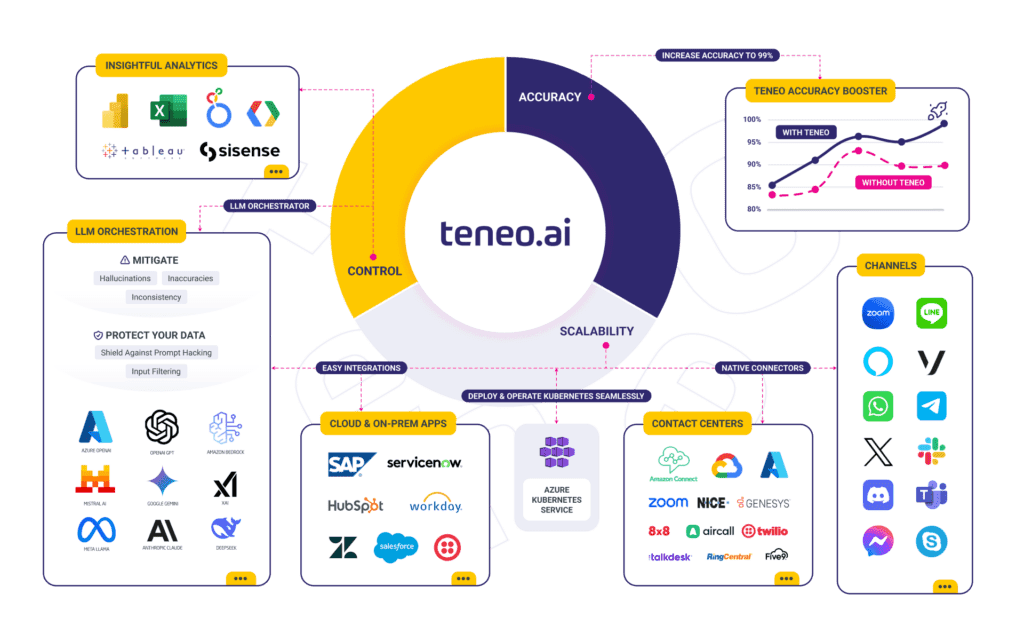
Teneo is the intelligent control layer that transforms your LLM strategy from a high-risk commitment into a resilient, competitive advantage. We allow enterprises to seamlessly manage a diverse fleet of LLMs, ensuring performance, mitigation of hallucinations, increased efficiency, and scale across 86+ languages.
With Teneo LLM orchestration, you gain the power to:
1. Route for Precision: Right Model, Right Moment
Stop over-relying on a single, expensive model. Teneo’s native orchestration layer dynamically routes every user query to the optimal engine:
- GPT-5.1 for complex reasoning and general tasks.
- Claude 4.5 for sensitive interactions and deep, long-form context.
- Gemini 3 for workflows requiring native integration with Google Workspace.
2. Eliminate hallucinations with Hybrid AI
The LLM’s Achilles’ heel is hallucination, a problem that according to NVIDIA CEO Jensen Huang is “several years away” from being solved by the models themselves.
Your enterprise cannot afford to wait several years to get rid of hallucinations. The definitive solution is the Teneo Hybrid AI. This platform is specifically engineered to provide up to 99% accuracy, utilizing its native hybrid approach to deliver verified, trustworthy, and scalable Agentic AI today.
- Blend AI with rules: Use AI for flexible replies and rule-based steps for structure all in a single conversation
- Stay in control when it counts: Keep key steps predictable and compliant while letting AI handles natural conversations
- Reduce Risk with Smaller, Clearer Tasks: Break Guides into focused steps to avoid hallucinations and improve accuracy
- Scale confidently and deliver consistently: Combine the flexibility of AI with the reliability of structured flow to achieve desired outcomes
3. Maximize ROI: Control Cost and Performance
Instantly optimize every interaction for cost.
- Route simple, high-volume queries to cheaper, faster models.
- Reserve frontier models for truly complex tasks that justify the expense.
- Test new models in a shadow environment without ever impacting existing customer experience (CX).
Want to experience it live?
The LLM race is intense, but your competitive advantage depends on orchestration, not just adoption.
Don’t get locked in. Contact us to learn more!

Ramazan Gurbuz
Product Marketing Executive at Teneo.ai with a background in Conversational AI and software development. Combines technical depth and strategic marketing to lead global AI product launches, developer initiatives, and LLM-driven growth campaigns.