
Voice AI is quickly becoming a core interface between businesses and customers. From customer support automation to voice-enabled assistants, organizations are investing heavily in conversational systems to improve service and efficiency.
However, one factor is often underestimated: development speed. When Voice AI development moves slowly, the impact extends far beyond delayed launches. Slow iteration cycles can quietly increase costs, weaken customer experience, and limit the ability to compete in a rapidly evolving market.
Understanding these hidden costs is essential for teams building modern Voice AI solutions.
Why Voice AI Development Often Becomes Slow
Voice AI projects are complex. They have more recently evolved into Agentic AI procedures that can integrate with business systems, and continuous optimization based on real user behavior.
Several factors typically slow teams down:
- Fragmented development and testing environments
- Delayed feedback loops between designers, developers, and QA teams
- Limited ability to test realistic conversational scenarios
- Dependence on lengthy deployment cycles to evaluate changes
When testing and validation happen late in the development process, teams lose valuable time identifying issues that could have been caught earlier.
The result is a slower path from idea to production. In this article, we will talk about the 5 Hidden Costs of Slow Voice AI Development.
Hidden Cost #1: Longer Time to Market
Voice AI is often deployed to improve operational efficiency or customer satisfaction (CSAT). When development cycles stretch longer than expected, companies delay those benefits.

A slow rollout means:
- Higher operational costs remain in place longer
- Competitors may launch similar solutions first
- Innovation initiatives lose momentum internally
Speed is not only about convenience. It directly affects business outcomes.
Hidden Cost #2: Expensive Iteration Cycles
Voice AI systems improve through iteration. Teams must refine intent recognition, conversation flows, prompts, and integrations based on testing and user feedback.

Without efficient testing capabilities, each improvement cycle becomes costly.
Typical slow workflows look like this:
- A change is implemented
- The solution is deployed to a test environment
- Testers simulate conversations
- Issues are discovered
- The cycle repeats
Each loop may take hours or days. Over the lifespan of a project, this inefficiency compounds significantly.
Hidden Cost #3: Poor Conversation Quality
Voice AI quality depends heavily on testing. Teams must validate:
- Intent recognition accuracy
- Dialogue flow logic
- Edge cases and fallback scenarios
- Integration responses
When testing is limited or delayed, many issues remain hidden until real users encounter them.

This leads to frustrating interactions such as:
- Repeated misunderstandings
- Broken conversation flows
- Incorrect responses from backend integrations
Poor early experiences can reduce trust in the system and harm adoption.
Hidden Cost #4: Reduced Team Productivity
Voice AI development is highly collaborative. Conversation designers, developers, QA specialists, and business stakeholders all contribute to the final experience.
Slow testing workflows create bottlenecks between these roles.
For example:
- Designers cannot validate conversation changes quickly
- Developers wait for feedback before continuing work
- QA teams spend excessive time reproducing issues
When teams cannot test ideas instantly, productivity drops and innovation slows.
Hidden Cost #5: Scaling Becomes Difficult
As Voice AI solutions grow, complexity increases. New intents, languages, integrations, and channels add layers of difficulty.
Without efficient development tools, scaling becomes risky and time consuming.

Organizations need platforms that allow teams to continuously test, validate, and improve conversational experiences without slowing down development velocity.
Why Real Time Testing Changes Everything
One of the most effective ways to eliminate these hidden costs is real time testing during development.
Instead of waiting for deployments or external testing environments, teams can validate changes instantly as they build.
Real time testing allows developers and designers to:
- Test conversation flows immediately
- Identify intent recognition issues early
- Validate integrations during development
- Experiment with different dialogue strategies
This immediate feedback loop dramatically accelerates Voice AI development.
How Real Time Testing Improves Voice AI Quality
One recent trend has started to emerge in order to tackle these hidden costs, and that is access to real time testing. Real time testing does more than speed up development. It also improves the final conversational experience.
Teams can quickly explore different design approaches and validate them with live simulations.

Benefits include:
- Faster debugging of conversation logic
- Higher intent recognition accuracy
- Better handling of edge cases
- Continuous refinement of the user experience
Instead of discovering issues late in the project, teams address them as they build.
The Role of Modern Voice AI Platforms
To support faster development cycles, organizations need platforms designed for iterative conversational development.
Modern Voice AI platforms provide capabilities such as:
- Real time testing environments
- Integrated development and conversation design tools
- Advanced NLU management
- Built-in analytics and optimization capabilities
Platforms like Teneo AI help teams reduce friction throughout the Voice AI lifecycle by allowing developers and conversation designers to test and refine interactions instantly during development.
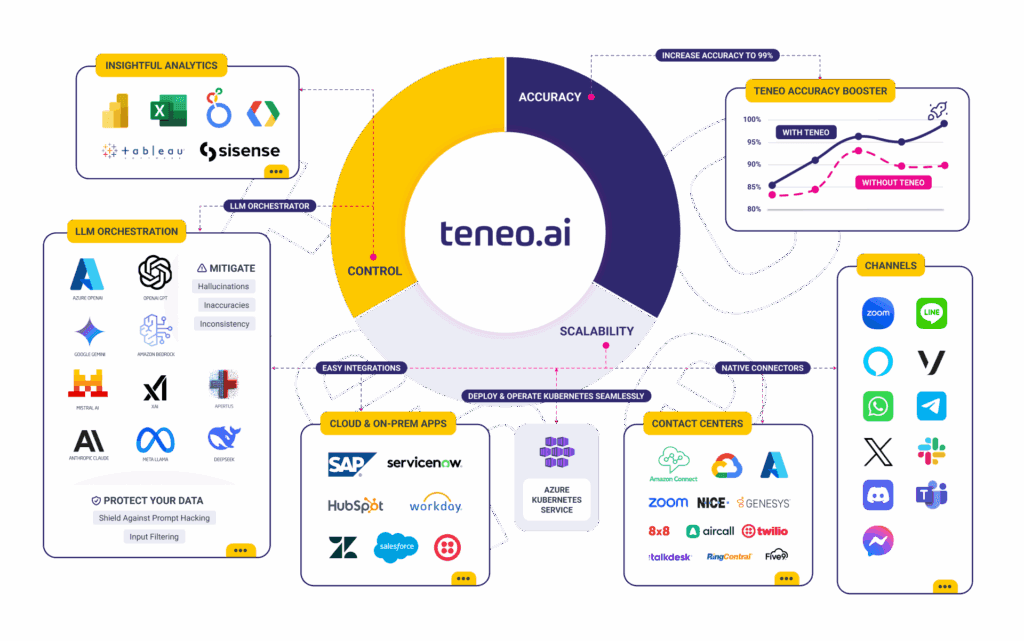
This enables organizations to move from concept to production faster while maintaining high conversational quality.
Building Voice AI Without the Hidden Costs
Voice AI is no longer an experimental technology. Similar to building and adopting LLMs like OpenAI GPT 5.4 and Google Gemini 3 in organizations, it is becoming a core component of digital customer experiences.
Organizations that succeed with Voice AI share one common trait: they optimize for fast iteration.
By reducing development friction and enabling real time testing, teams can:
- Launch Voice AI solutions faster
- Improve conversational quality continuously
- Empower cross functional teams to collaborate efficiently
- Deliver better customer experiences at scale
For organizations exploring the broader landscape of conversational technology, this comprehensive guide to Voice AI chatbots provides a deeper overview of how Voice AI systems work and how businesses can implement them successfully.
Discover Teneo AI Today!
The most expensive Voice AI problems are often invisible at first. Slow development cycles quietly increase costs, delay innovation, and compromise user experience.
The solution is not simply better models or more training data. It is better development workflows.