
For years, per-seat pricing has been the default way to buy contact center technology. It made perfect sense when service capacity was tied almost entirely to human agents. More demand meant more people. More people meant more seats. The model was simple, familiar and easy to explain: interaction volume drove agent demand, agent demand drove seat demand, and seat demand drove software cost.
But that old equation no longer holds.
Today, across the Contact Center as a Service (CCaaS) space—including platforms like Genesys Cloud—pricing still largely revolves around seats, often with usage-based AI tokens layered on top. When AI is already containing calls in production, the harder question is: Why are we still pricing customer service as if every interaction needs a human seat behind it?
When AI can resolve a significant portion of demand before it ever reaches an agent (indeed even before it reaches your CCaaS), the link between volume and seats becomes less linear. A business may still be paying for capacity as if every interaction needs live handling, even when a growing share of those interactions no longer does. That does not mean seats disappear overnight. It does mean the pricing model is beginning to reflect an older operating reality.
The Changing Value of a Seat
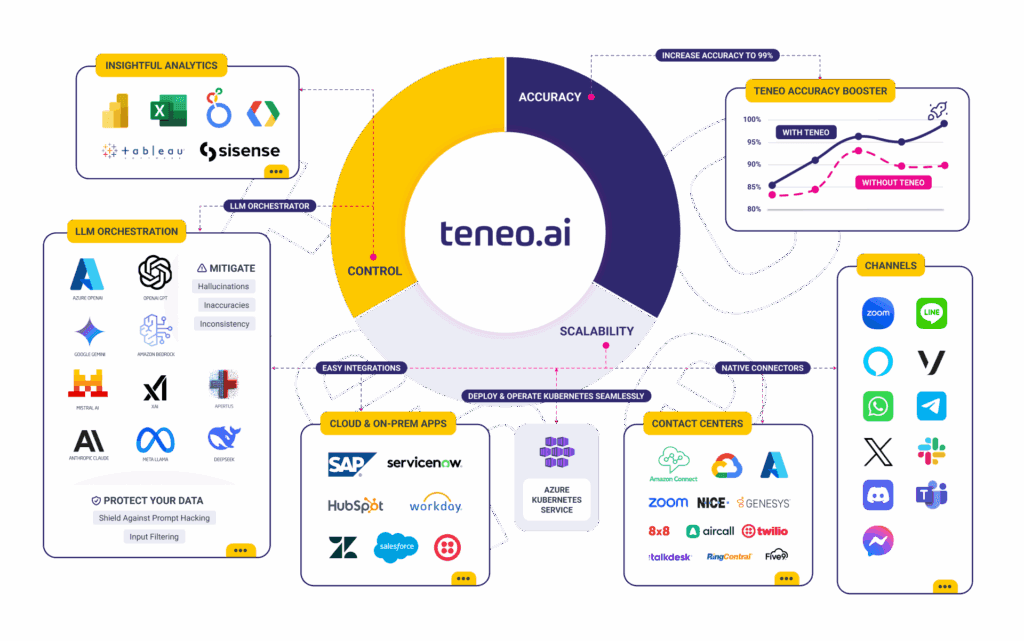
We already see AI contain a meaningful share of calls in live environments today. Teneo.ai has helped enterprises achieve over 60% call containment, saving millions monthly while delivering a fast, fully conversational experience. When AI is resolving a meaningful percentage of demand—even conservatively—the seat stops being the only meaningful unit of value.
If AI contains the call, what exactly is the seat paying for? That is the real question.
Of course, the platform still matters. Routing matters. Reporting matters. Governance matters. Human agents absolutely still matter. Your contact center is no longer just a human-capacity model with a little AI attached to it. It is a blended operating model, where some work is resolved by people, some by AI, and some by a combination of both.
Once that is true, pricing everything mainly around seats starts to feel less like a natural fit and more like an overpriced legacy habit.
Why This Matters for Genesys Cloud Customers
For organizations already running Genesys Cloud, this is not a platform replacement discussion. Most are not looking to rip out their CCaaS environment. They are looking for ways to reduce cost, improve efficiency and get more out of the stack they already have.
That is exactly where this pricing question becomes commercially important.
AI can contain 60% of routine demand, then the biggest savings do not come from squeezing a little more out of the license negotiation. They come from reducing the amount of live-agent effort required to support the same volume of customer demand.
That changes economics in a much more meaningful way. It affects queue pressure, handling time, repeat contacts, transfers, staffing pressure and how fast a business needs to expand its frontline operation as demand grows.
So the more interesting question is no longer just: What does each seat cost? It is: How much of our current demand still needs a seat at all?
CCaaS Pricing Needs a Reset
This is really the heart of it. The market has moved faster on AI than it has on commercial models. That is not unusual in enterprise software. Pricing frameworks tend to linger long after operating realities have changed. But if AI is already containing calls and reducing the need for live handling in real customer environments, then pricing that still revolves mainly around seats starts to look increasingly out of step with how service is actually being delivered.
We think that deserves more scrutiny. Not because seats are irrelevant—they are not. But because they are no longer the full story.
A Better Way to Think About ROI
Take an enterprise-scale operation handling one million calls per month. A rough estimate might put the required agent footprint at around 3,000 seats. Based on industry estimates, the average Genesys Cloud seat price comes to roughly $158 per user, per month.
From that perspective, the cost implications of AI containment become hard to ignore.
| Scenario | Calls Contained | Estimated Savings Rate | Monthly Savings |
| Conservative | 30% | 30% of seat cost | $142,200 |
| Moderate | 40% | 40% of seat cost | $189,600 |
| High Containment | 60% | 60% of seat cost | $284,400 |
That brings us back to the real question. We have largely moved past debating whether AI belongs in customer service. It does.
What is far more interesting now is whether CCaaS pricing has kept pace with what AI is already making possible. If AI can already contain calls in production, reduce the amount of routine demand reaching agents and lower the cost to serve, then per-seat pricing starts to look less like a natural foundation for the model and more like a holdover from a pre-containment era. Discover your own potential ROI here.

Closing Thoughts
For companies already invested in Genesys Cloud and other CCaaS platforms, this is an easy question to address, not a difficult one.
If AI is already reducing the amount of human effort required to handle customer demand, then it may be time to rethink whether the seat should still sit at the center of the cost conversation.
We think the answer is increasingly no.


Contributors:
Ramazan Gurbuz
Product Marketing Executive at Teneo.ai with a background in Conversational AI and software development. Combines technical depth and strategic marketing to lead global AI product launches, developer initiatives, and LLM-driven growth campaigns.
Per Ottosson
Per Ottosson is the CEO and a board member of several subsidiaries of Teneo AI AB. He has more than 25 years of experience in senior executive roles within the global software and SaaS industry.