

It is Saturday morning. A customer’s washer stops mid-cycle, water sitting in the drum. They call your support line because they want an answer now, not a ticket number. Your agents can help, but the queue is already backed up with the usual suspects: error codes, “not cooling,” “won’t start,” delivery questions, and warranty checks.

An AI voice agent for appliance support is designed for exactly this moment. It handles the high-volume, repeatable interactions that slow teams down, guides customers through safe troubleshooting, and hands off the complex or sensitive cases to a human with full context. The goal is not to replace your agents. It is to reduce friction for customers and cost for the business, while improving consistency across every call.
Why appliance support is ideal for voice automation
Appliance issues are physical and step-based. Customers are standing in front of the product, juggling buttons, doors, filters, hoses, and error codes. Voice is naturally suited to walk someone through “do this, then that,” without requiring them to type.

At the same time, appliance support has predictable patterns. A handful of symptoms and error codes drive a large share of calls, and most resolutions follow approved scripts from manuals and service organizations. That repeatability is where automation delivers ROI, especially during seasonal spikes and product launch periods when staffing becomes expensive.
What a good AI voice agent actually does
A modern AI voice agent is more than voice hooked into a LLM like OpenAI GPT-5.2 or Google Gemini 3. In appliance support, it should behave like a capable service concierge:
- Understand intent in natural language (“My dryer is squealing and smells hot”)
- Collect the right details quickly (model, serial number, error code, symptoms, when it started)
- Guide safe troubleshooting using approved steps, with short prompts and clear confirmations
- Take action through integrations (warranty checks, scheduling, order status, parts ordering)
- Escalate smoothly when the situation is complex, emotional, or safety-related

The difference between a good and bad experience is whether the system can resolve the issue, not just talk about it.
High-impact use cases to start with
If you want early wins, focus on a small set of intents that are high volume, well defined, and measurable.
1) Error code help and guided troubleshooting
Customers call with a code or flashing pattern. A voice agent can confirm the model, interpret the code, run through safe checks (power cycle, filter, drainage, door latch), and determine whether the customer is back in business or needs service.
2) Warranty and entitlement checks
“Is this covered?” calls consume agent time and create inconsistent answers. A voice agent can verify identity, check warranty status, explain coverage boundaries, and route the customer to the right next step.
3) Service scheduling and rescheduling
Scheduling is a strong automation candidate when it connects to field service systems. The voice agent can collect symptoms, confirm address, offer appointment windows, and add troubleshooting notes so technicians arrive prepared.
4) Order, delivery, and installation status
Retail and D2C appliance businesses get a steady stream of “where is my delivery?” questions. A voice agent can pull real-time status from order and carrier systems and explain next steps, reducing inbound load.
What to look for in a solution
Not all voice automation is enterprise-ready. When evaluating platforms, prioritize:
- Voice experience quality: low latency, natural interruption handling (barge-in), clear prompts
- Control and governance: approved troubleshooting flows, auditability, and safe escalation rules
- Integration depth: CRM, warranty, product registration, knowledge base, field service, and OMS
- Analytics that drive improvement: containment by intent, transfer reasons, drop-off points, repeat-call rates
- Handoff with context: agents should receive a summary of model, symptoms, steps attempted, and customer details
A common pitfall is trying to “automate everything” or relying on unstructured manuals. Start with a narrow scope, build reliable flows, and expand only when the data supports it.
Where Teneo fits
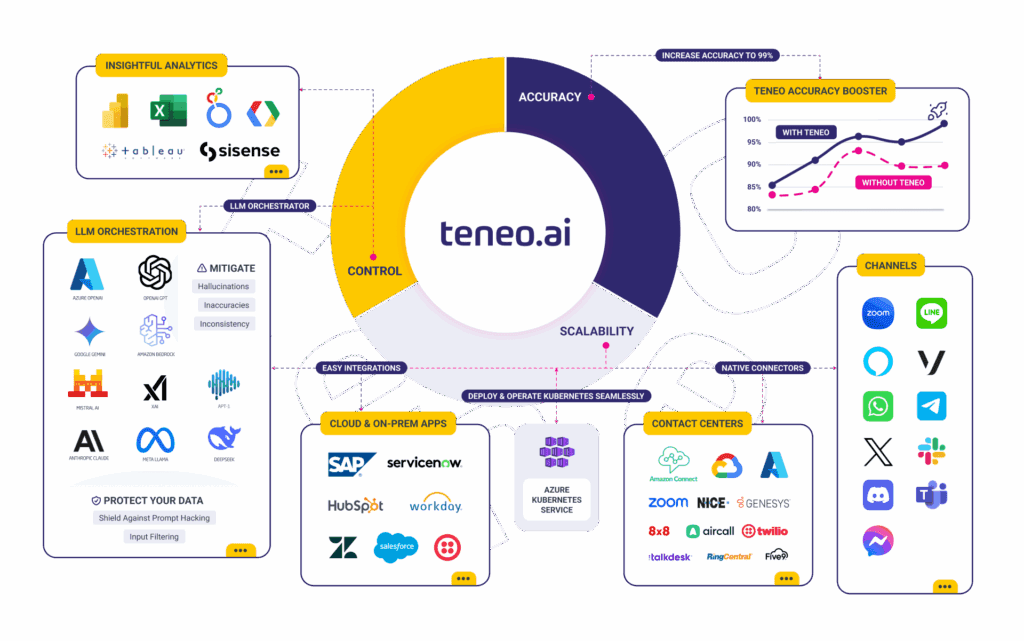
Platforms like Teneo help enterprises deploy AI agents for major household appliances industry that work across voice and digital channels while integrating with contact center and back-end systems. In practice, that means you can automate Tier 1 appliance support (like error codes and scheduling), keep customer context consistent across channels, and ensure seamless transfers to agents with the right information already captured. The focus stays on measurable outcomes: lower queue pressure, improved resolution consistency, and better customer experience.
Next steps to get started
If you are planning an AI voice agent for appliance support, keep it pragmatic:
- Identify your top 3 to 5 call drivers by volume and cost (handle time, repeat calls, dispatch impact).
- Define “done” outcomes for each intent (resolved remotely, scheduled service, status provided).
- Build approved troubleshooting flows and safety rules with clear escalation triggers.
- Pilot with real integrations so the voice agent can take action, not just answer questions.
Done right, an AI voice agent becomes a pressure valve for your operation and a relief for customers: fewer long waits, fewer repeat explanations, and faster paths to resolution. Contact us to learn more!