
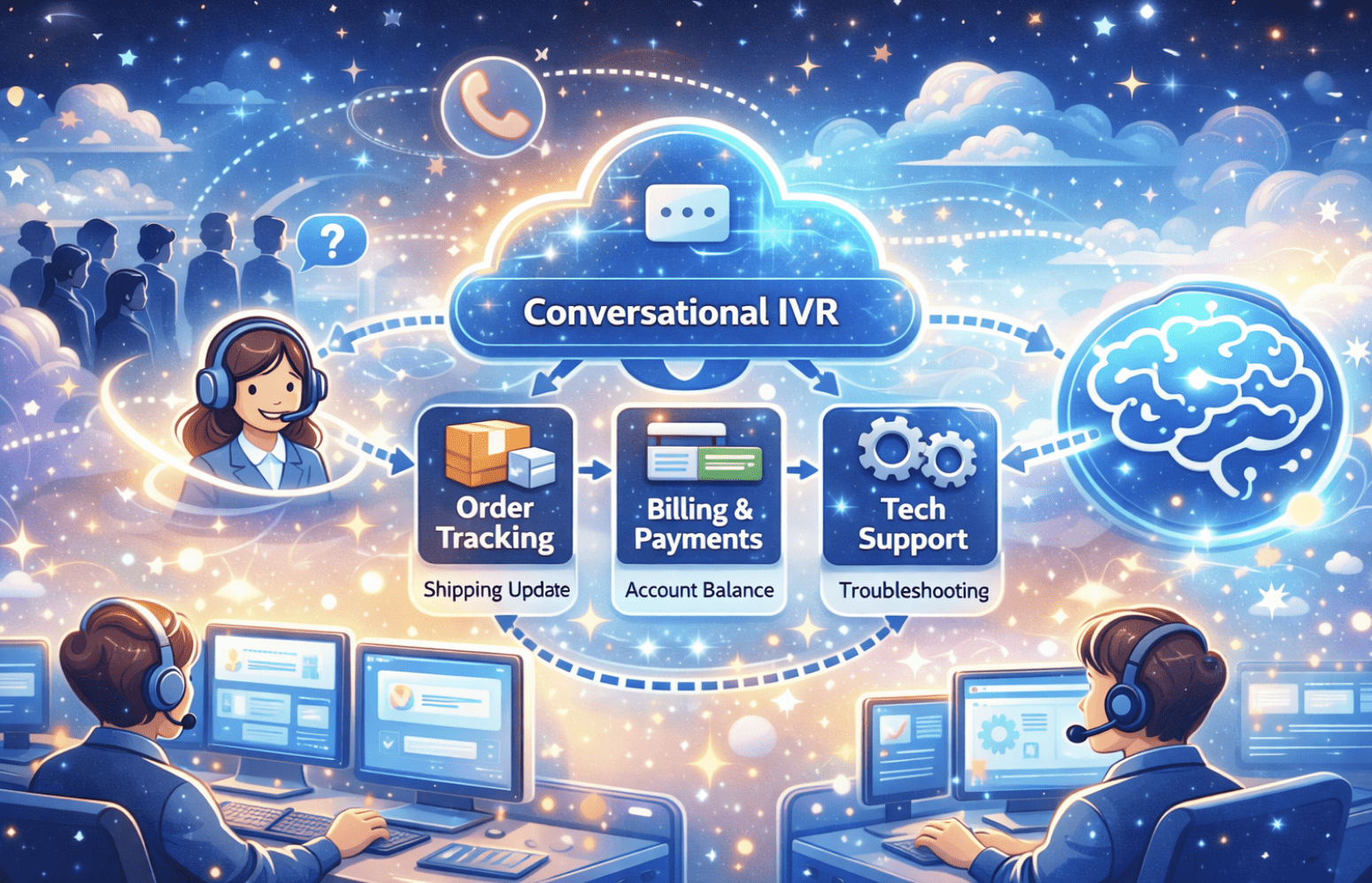
If you manage a contact center, few metrics are as immediately painful as abandon rate. It’s the clearest signal that customers are giving up before they ever get help. And when a caller hangs up, you don’t just lose a conversation. You risk losing trust, revenue, and future loyalty.
In this post, we’ll break down what abandon rate is, what drives it, how to measure it properly, and the most effective ways to reduce it. We’ll also look at how a conversational approach to IVR, like Teneo Conversational IVR, can help improve the experience without forcing every caller into a queue.
What is abandon rate?
Abandon rate (often called call abandonment rate) is the percentage of inbound calls that disconnect before reaching an agent. Abandons typically happen when callers experience long wait times, confusing menus, or repeated transfers.
A high abandon rate usually indicates:
- Your demand is exceeding your capacity at key times
- Customers are getting stuck before they reach the right destination
- Self-service is not resolving issues quickly enough
Why abandon rate matters more than you think
Abandon rate is often treated as a staffing issue. Sometimes it is, but it is also a customer experience issue.
When abandon rate rises, it can trigger a chain reaction:
- Lower CSAT: Customers remember the effort, not the intent
- Higher repeat contacts: People call back later, creating even more volume
- More pressure on agents: The calls that do get through are often more frustrated
- Lost conversions: Sales and renewals suffer when customers can’t reach you
Even if your average handle time and agent performance look solid, a high abandon rate can reveal friction happening earlier in the journey.
How to calculate abandon rate
A standard formula is:
Abandon Rate (%) = (Abandoned Calls ÷ Total Inbound Calls) × 100
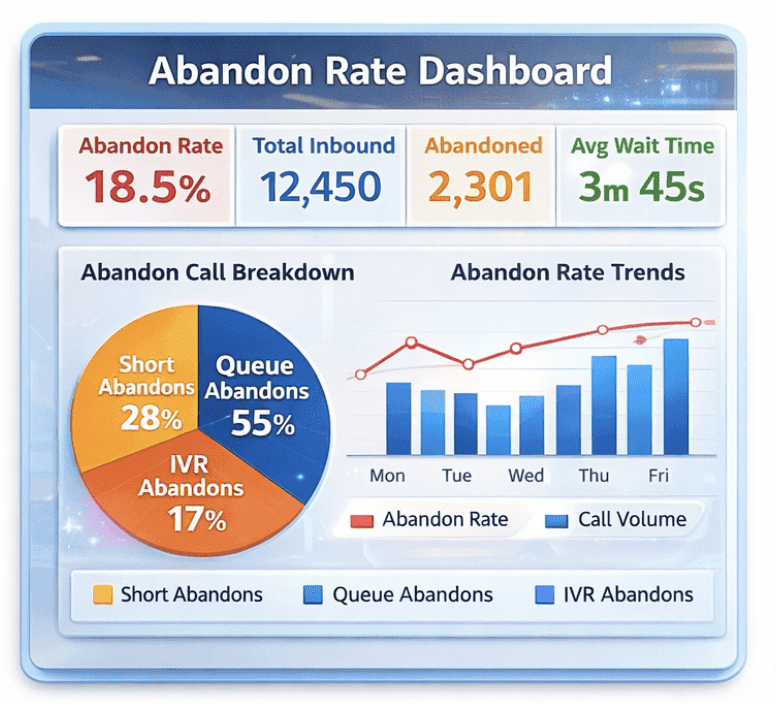
To make this metric more useful, consider separating abandons into categories:
1) Short abandons
Calls that drop within a few seconds. These can include misdials, wrong numbers, or immediate hang-ups.
2) Queue abandons
Calls that drop after the caller enters the queue. These often correlate strongly with long wait times.
3) IVR abandons
Calls that drop during self-service. These suggest confusion, dead ends, slow flows, or callers not finding the right option.
Tracking these separately helps you identify whether you have a capacity problem, an experience problem, or both.
Common causes of high abandon rate
Long wait times and slow speed of answer
When customers hear “your call is important” for several minutes, many decide it is not worth staying. Abandon rate tends to spike sharply after certain wait-time thresholds.
Poor routing and too many transfers
If callers reach the wrong team, or have to repeat information across transfers, they drop more often. The journey feels longer even if the total time is similar.
Complex IVR menus
Long lists of options, unclear prompts, and circular menus increase frustration and lead to IVR abandons. People call because they want progress, not a maze.
Volume peaks without dynamic handling
Even well-run centers can get overwhelmed during campaigns, incidents, billing cycles, or seasonal spikes.
Lack of meaningful self-service resolution
If self-service only deflects but does not actually resolve, callers will attempt it briefly and then hang up or call again.
How to reduce abandon rate: practical tactics that work
1) Improve routing accuracy early
The fastest call is the one that reaches the right destination the first time.
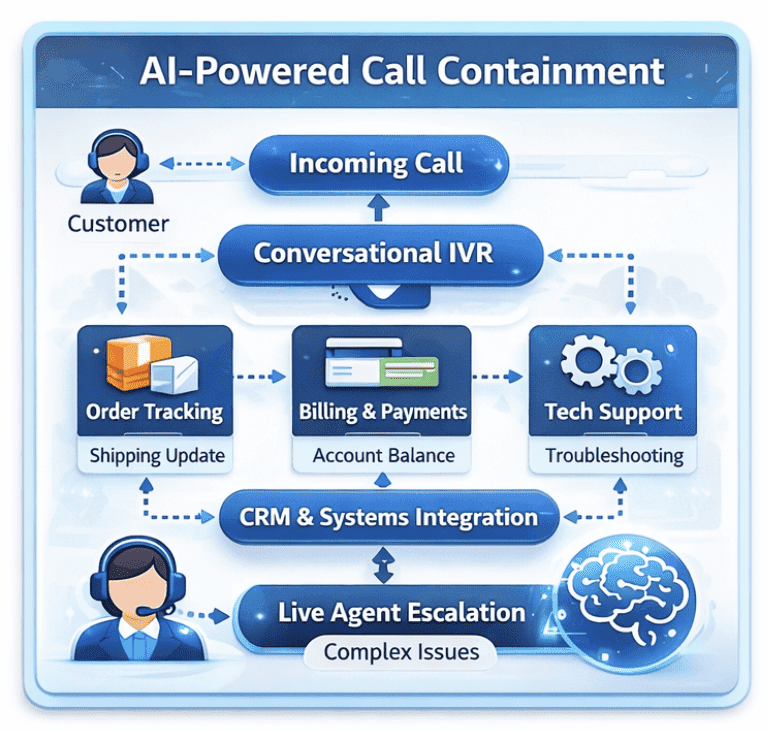
A conversational front door can capture intent early and route callers to the best-fit team, queue, or self-service flow. That means fewer transfers and less time spent waiting in the wrong place.
Where Teneo.ai fits: Teneo Conversational IVR can be used to understand what the caller wants in natural language and use that intent to route more precisely than rigid menu trees.
2) Reduce IVR friction with self-service
Traditional IVR asks callers to adapt to the system. Teneo Agentic AI flips this scenario by solving the question without ever reaching an live agent.
This helps reduce IVR abandons by:
- Shortening the time to the right path
- Avoiding long option lists
- Handling routine questions without forcing an agent interaction
Example outcomes to aim for: fewer steps, faster resolution, fewer dead ends, and higher call containment.
3) Offer callback at the right moment
Callback can reduce queue abandons, but timing matters. Offer it when the predicted wait crosses a meaningful threshold, and confirm the number and reason to minimize drop-offs.
4) Use “containment with completion”, not just deflection
Deflection without resolution usually creates repeat contacts. The goal is to complete common tasks end-to-end in self-service, such as:
- Order status and delivery updates
- Balance and billing questions
- Appointment changes
- Password resets and account access
- Simple troubleshooting steps
The more complete the outcome, the lower the abandonment.
5) Fix the top abandon drivers with a journey view
Abandon rate is rarely evenly distributed. Find the top drivers by slicing:
- By hour and day
- By queue or skill group
- By entry point and IVR path
- By call reason or intent
- By language or region
Then focus on the two or three flows that contribute the most abandons. Small changes in the right place often beat large changes everywhere.
A Teneo.ai approach: lowering abandon rate by improving the front door
Reducing abandon rate is not only about adding agents. It is about removing friction and getting customers to resolution faster.
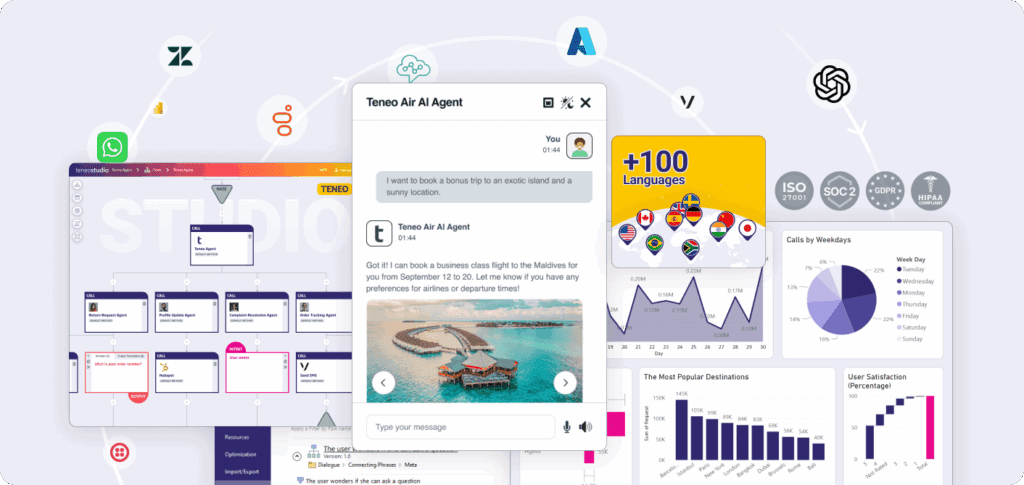
Teneo.ai can support that by:
- Capturing caller intent with precision at scale, using LLM-orchestrated NLU to classify and route calls in real time so customers reach the right destination immediately.
- Driving call containment, using native Agentic AI across 86+ languages to complete end-to-end Level 1 requests and automate up to 50% of repeatable Level 2 work, without forcing callers through rigid menus.
- Orchestrating tools and systems to resolve personal, high-value intents, securely connecting to CRM, order systems, billing, knowledge bases, and case management so customers get outcomes, not just answers.
- Protecting service levels during peak volume, deflecting and resolving the highest-volume intents before queues spike, reducing abandons while keeping agents focused on complex, high-empathy cases.
The best results come from pairing automation-first containment with operational discipline, aligning forecasting and queue strategy with conversational routing, self-service completion, and agentic workflows that continuously expand what can be automated.
FAQ
Is abandon rate always bad?
Not always. Very short abandons can be noise, and some callers hang up because they found the answer elsewhere. But rising queue or IVR abandons usually indicate a fixable experience problem.
Should I exclude short abandons from the calculation?
Many centers do, or at least report them separately. It helps avoid misinterpreting misdials as customer frustration.
What is the fastest way to reduce abandon rate?
If wait time is the main driver, callback and better staffing coverage can help quickly. If routing and IVR friction are major drivers, simplifying the entry experience and using conversational intent capture can reduce abandons without adding headcount.